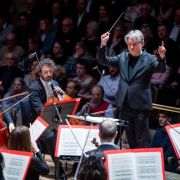
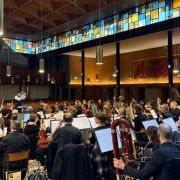
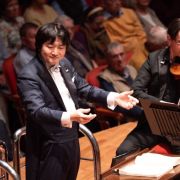
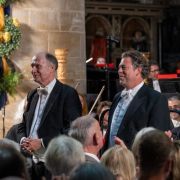
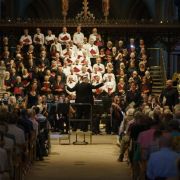
Concerts are often at their most interesting when big tentpole works pale in significance and impact beside much smaller, less familiar music. So it was in Gloucester Cathedral on Wednesday where the Three Choirs Festival was treated to a spirited performance of Beethoven’s flamboyant Mass in C.

There was nothing wrong with it. If anything, Samuel Hudson clearly wanted to maximise the idiosyncrasies of the work, above all the fact that it’s not really a Mass – at least, not in a eucharistic sense. The words work less as a vehicle for religious expression than musical invention, and while that makes Beethoven’s Kyrie sound complacent rather than imploring, it does at least provide the work with that most rare of choral commodities: a genuinely interesting Credo. This was where the work sounded at its best, choir and orchestra (and soloists, although only Mark Padmore was consistently pleasant to listen to) revelling in the dramatic twists that go far beyond what the words usually inspire. The closing Agnus Dei worked strongly too, finally providing a hint of that spiritual fervour missing from the Kyrie, the Three Choirs Festival Chorus at their most plangent and heartfelt.


Unsurprisingly, the Beethoven occupied the entire second half of the concert. The contrast with what went before wasn’t simply one of epoch – 20th- and 21st-century works – but of statement. Beethoven could hardly have been more direct, whereas the music in the first half took a very different, arguably more compelling approach.
Not in Cecilia McDowall’s inert Rain, Steam and Speed, but her A Song for St Cecilia was altogether more engaging. Light and lilting, trumpets lending a touch of brightness, the text unfolded like a swaying dance. It was curiously hypnotic, reinforced by drones and cycling pulses, out of which soloists spiralled. Its atmosphere, appropriate for the weather, was filled with balmy wooziness. The words thereby took on the quality of a mantra, articulated indirectly, rather dreamily. This was no conventional paean but a heady, even mildly intoxicated reverie, positively basking in warmth.
The real triumph of the evening came from one of Britain’s more obscure composers, Edmund Rubbra. Between 1935 and 1980 he composed no fewer than 11 symphonies, though actually encountering them in concert halls is exceedingly rare. Kudos, then, to whoever thought to make his Tenth Symphony, “Sinfonia da camera”, the centrepiece of the first half. On the one hand, it’s a compressed piece, four seamless movements occupying a 15-minute span. Yet Hudson made much of the work’s surprisingly expansive quality, and above all the fact that its mode of expression is decidedly ambiguous.


Thus, the opening, low-key and low-register, was felt to be not exactly brooding but a curiously dark-hued lyricism. Even when the violins raised things they continued to ring solemn. Deep pedal points underscored this, though it became apparent that there was an understated sumptuousness running through the music, and after a time it even gently began to dance. That sounds like a gradual opening out – yet paradoxically it felt like the opposite: turned inward, perhaps even guarded. It was as if the Philharmonia were pulling a veil over themselves, an oboe melody (a recurring presence in the symphony) just about rising through the strings’ textural haze. Melancholic? Hard to say, yet the music’s liminality, holding back yet implicitly ardent – primarily in the multitude of individual strands running through the piece – proved utterly mesmeric. An enigmatic symphony certainly, but never an aloof one, and in ways hard to articulate, deeply moving.