At Washington National Opera, there was a standing ovation from the sold-out audience before even a note was sung. Introducing its first production since decamping from the Kennedy Center, WNO General Director Timothy O’Leary and Artistic Director Francesca Zambello spoke to their belief in creative freedom, reminding us that the arts are owned by we, the people. Scott Joplin’s crowning achievement, Treemonisha, was particularly apt for the occasion. Central to his 1911 opera are themes of education over fear and community over manipulation, subversive in its time and still strikingly relevant today.

Though the undisputed master of the piano rag, Joplin long had ambitions to write in larger-scale forms. An earlier opera was tragically lost and other projects either met the same fate or never came to fruition. Treemonisha thus remains the clearest evidence of Joplin’s broader aspirations, and a tantalizing taste of what could have been had the composer lived a longer life. It’s also a work that can be troubling for purists as a good deal of conjecture is needed to realize Joplin’s conception as only a piano-vocal score remains.


Others have been left to orchestrate the work with little evidence how Joplin would have approached orchestration. The present version was undertaken by Damien Sneed who devised a convincing, idiomatic scoring cast for a modestly-sized orchestra, along with prominent onstage parts for piano (performed by Sneed himself) and banjo (DeAnte Haggerty-Willis). Sneed has a long connection to the work, having worked as accompanist in the voice studio of Carmen Balthrop who sang the title role in the watershed 1975 production at Houston Grand Opera, and was further encouraged to champion the work by his godmother – no less than Jessye Norman.

Writer Kyle Bass was engaged to expand the libretto from Joplin’s original with additional lyrics and spoken word passages. These additions strengthened the dramaturgy, filling gaps and smoothing the sometimes heavy-handed narrative. The original three act structure was redistributed into two, with some shuffling done – for instance, the jubilant “Aunt Dinah Has Blowed de Horn” was moved up near the beginning. And a new and quite affecting aria was fashioned for Treemonisha to the melody of Please Say You Will, Joplin’s first published work.
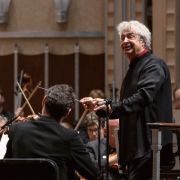
Conductor Kendrick Armstrong skillfully led the cast across a wide variety of styles, from music drawing on the classical operatic tradition to ragtime, folk tunes, church music and even barbershop quartet. The overture set the tone with some quintessentially Joplinesque syncopations and the curtain rose to reveal the brightly-colored, intricately-patterned set. Under the direction of Denyce Graves, staging during the overture brought the backstory to life wherein Treemonisha was found as an infant underneath a sacred tree, and sent away to be educated before returning to her close-knit African-American community in Reconstruction-era Arkansas. The orchestra was the further focal point during Frolic of the Bears capturing the mystery of the forest when Treemonisha is captured by The Conjurers, a band of men who try to dupe the townspeople into buying superstitious “bags of luck” – and thus see the educated Treemonisha as their enemy. The Prelude to Act 3 was a touching interlude, though the dialogue and action superimposed upon it distracted from the wistful melody.


Treemonisha is not a flashy role like a Verdi or Puccini heroine, but one that requires a commanding stage presence through a quiet confidence. Viviana Goodwin achieved this beautifully through a soprano voice robust yet delicate, conveying wisdom beyond her years. Dressed distinctly from her counterparts, her costume too conveyed her marked status. I found her particularly compelling in “Conjurers Forgiven” wherein she implores the townspeople to forgive instead of punish, offering a moral compass. “We Will Trust You As Our Leader” was a dialogue between Treemonisha and the community, with the latter offering their wholehearted support for her guidance and compassion – and the line “ignorance is criminal” drew applause from the audience.

As Remus, Justin Austin was Treemonisha’s good-natured companion, rescuing her from the forest, and amplifying her plea for forgiveness in the imposing “Wrong is Never Right”. Leader of the conjurers was Zodzetrick, sung by Jonathan Pierce Rhodes. Almost cartoonish in both dress and gesture, he was captivating as the opera’s primary villain. As Treemonisha’s adoptive mother, Tichina Vaughn’s maternal mezzo was particularly affecting in “The Sacred Tree”, speaking of her daughter’s origins. The bass-baritone of Kevin Short made a fitting counterpart as her father, Ned. Among the smaller parts, Nicholas LaGesse stood out as Parson Alltalk, portraying a powerful preacher.
I was most struck by the pieces for ensemble, culminating in the hauntingly beautiful “A Real Slow Drag”. With its invocations to keep “marching onward”, it made for a close not just powerful in message, but festive and communal in spirit.