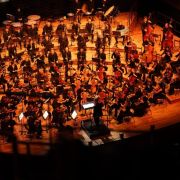
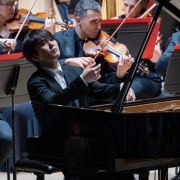
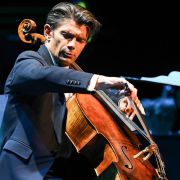
The power of three was to the fore at the Royal Festival Hall where the Philharmonia was joined by Leonidas Kavakos (sans violin) and cellist Kian Soltani (with a Stradivari) to give around 100 minutes of refined artistry, in a programme of works by Schumann, Brahms and Dvořák. To describe both trios as axes of power is not to invoke bellicose connotations; rather, it is to recruit that idea for the force that energised orchestral and instrumental playing of a very high order, tangible from the first bar to the last. It also acknowledges the encouragement Schumann gave to Brahms, and the latter’s championing of Dvořák’s early work.


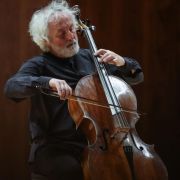
Schumann’s Cello Concerto in A minor is a work that has the structure of a gathering where the soloist is first among equals, and that is how it was here presented; no grandstanding or extrovert showmanship. Soltani’s natural gift as a persuasive communicator was evident in all his utterances, typical of which was honeyed intonation producing a luscious bloom, and eloquent cantabile suggestive of a fine Lieder tenor. Phrases began with an illuminated capital and ended with a cursive flourish; his movement contributed to an elegant pas de trois with Kavakos and the orchestra as they lovingly unfolded the continuous narrative. Appreciative applause was graced with Reza Vali’s arrangement of a Persian folk song.
Kavakos is enamoured of Brahms’ First Symphony to the point of scoreless advocacy. For him, in this colossus of a work there is no place for melancholic moroseness sitting heavily on the brow. What he did show, with forceful conviction, is that the piece is a superb example of the classical balance of grace and poise, wonder and grandeur, in which he recruited the unswerving support of Philharmonia. The playing was superb in all departments; the grace and poise was provided by the strings and the woodwind, and the wonder and grandeur epitomised by the gorgeous sound of the brass. The appearance of the Alpine theme and the chorale are two of the greatest moments in Brahms’ symphonic writing and here the players did not disappoint. Kavakos can sing this work to me any time he likes.


The overture to Dvořák’s Vanda, and indeed the opera itself, does not often get an outing, but the former enjoyed a visit to the RFH and was welcomed as a bottle of fizz to keep the Philharmonia’s 80th birthday party going. It works very well as a thumbnail sketch for the tale of the eponymous Polish queen who makes an heroic sacrifice for her nation’s independence. Its opening gesture is like the mark of Zorro, the composer proudly displaying his Bohemian badge before enthralling with his melodic gifts. Kavakos and the orchestra obligingly and stylishly supported Her Majesty in doing the honourable thing.