Billed as an “imaginative meditation”, Deborah Warner’s production of one of Britten’s masterpieces is certainly a grimly-imagined narrative of psychological terror driven by mob rule. But it doesn’t seem to be the result of any meditative processes. It is a hard-bitten political exposé, fully on-message about the corrosive forces at play in contemporary society. Replete with tub-thumping vigilantes, tattooed flag-wavers and savage effigy-torturers, it is a juggernaut that stops only briefly to seek out its next object of interest. To the question posed by the originators of the drama, “Who can turn skies back and begin again?”, the juggernaut must surely be the answer. Warner spotlights the humanising influences that might occasionally temper the ghastliness of oppression, scapegoating and alienation, but the beast is forever with us and its insidiousness is here grimly and fantastically evoked.


The opening image is immediately arresting; what looks like a beached creature of unspecified species is revealed to be Grimes, already snared by his fishing net. His interrogation is meant to be a dream, but in reality he is at the tender mercy of the Inquisition, with Clive Bayley’s Swallow revelling in his work as Tomás de Torquemada. Allan Clayton’s fisherman is no match for the baying mob and even his allies, Maria Bengtsson’s Ellen and Sir Bryn Terfel’s Balstrode, are here associated with his tormentors. In the end it is Balstrode, with Ellen’s collusion, who tells Grimes to destroy what’s left of himself. These three singers gave terrific vocal performances in which Clayton’s adamantine delivery was counterpointed by Terfel’s grittiness and Bengtsson’s cultured luminosity. The abiding image is of Grimes as a wreck of flesh and blood, kept prisoner by the fishing net used as a shroud for his apprentice and by his effigy, savagely abused and discarded by the vigilantes.

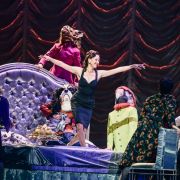
One of the ways in which Warner hints at a countervailing force at work is a heightened depiction of the roles of women in the Borough. There is a tableau where Auntie (Catherine Wyn-Rogers), the two Nieces (Jennifer France and Natalia Labourdette) and Ellen, sing of comforting men from ugliness, sheltering them from the storms and soothing away their fears, and mothering them as children for the bitter treasure of their love. Set in a shimmering light, it was superbly sung and sensitively accompanied.
Christine Rice’s graphic portrayal of Mrs Sedley outs her not just as an interfering busybody, but also as a vicious rabble-rousing stone-thrower. The Nieces are shown to be more than just “good time girls”; they are assertive mockers of gross sexual harassment and, like all the other women – except Ellen – take their place in the roll-call of vigilantes. All the other named roles gave solid vocal and acting performances, obedient to the mantra of live and let live, and keeping their hands to themselves. The exception was Jonny Imbrailo, John the apprentice and object of Grimes ‘at his play’. He was the only one at whom no one could point a finger.


Robustly underpinning this great evocation of a community in thrall to its passions is Michael Levine distinctive sets – a torture chamber and a coastal wasteland – illuminated by Peter Mumford’s menacing torchlights, a sleazy sodium streetlamp and a seascape almost resembling a screen of barbed wire. Kim Brandstrup is a go-to choreographer for rent-a-mob hooligans; and William Spaulding made those hooligans, in the from of the Royal Opera Chorus, bare their vocal fangs dripping with venom.

Jakub Hrůša and the Orchestra of the Royal Opera House summoned up eerie depictions of the sea and all its works and added the sting to the baying of the mob. Hrůša really got under the skin of the score and, to mix metaphors, landed some solid punches. At the close of the drama when the good people of the Borough are about their daily business, not bothering about reports of a boat sinking far out of sight, Hrůša lingered long enough for us, the audience, to remember that in Pieter Bruegel the Elder’s picture Icarus is not waving but drowning.