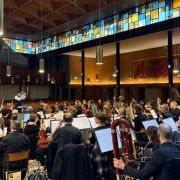
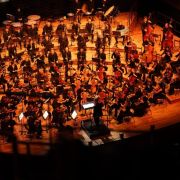
One mark of genius is never retreading old ground, and Puccini set himself new challenges in each of his eight mature operas. Another, related marker is the drive to improve on old work, either by revising it or by addressing its perceived faults in new pieces. None of those eight works was so subject to reconsideration as La rondine, Puccini’s perennially underrated take on Viennese operetta. Through various quirks of fate, the composer’s final version has never been heard – until now, thanks to Ditlev Rindom’s new edition and forces assembled by Opera Rara for a studio recording and this one-off concert performance at the Barbican.

Puccini himself declared that he would never write a true Viennese operetta and he effectively invented, perfected and completed a new genre with La rondine. His Italian librettist overhauled a plot which the composer dismissed as tawdry and clichéd. The finished piece, in all its versions, revisits tropes from Johann Strauss’ Die Fledermaus as well as Verdi’s La traviata and Puccini’s own La bohème. After the premiere in Monte-Carlo in 1917, what continued to perplex the composer was the ending. The familiar version drifts off on a gentle cloud of wistful resignation as the eponymous, itinerant ‘swallow’ of the opera’s title, Magda, determines that her love affair with the young and upright Ruggero is another, passing dream from which her past life as a Violetta-ish grande horizontale compels her to wake up.


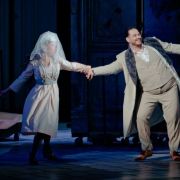
In Puccini’s final thoughts, from 1921, Ruggero confronts Magda with evidence of this past, hitherto concealed from him, and bitterly rejects her. Ermonela Jaho made a tragic denouement of pure melodrama from her final sigh, as if in tune with the accompanying bells that had tolled with the same fateful ring in Suor Angelica.
In fact, the whole performance allowed us to appreciate the degree to which Puccini learnt from his models, and then made them his own. A brief ‘new’ Act 3 scene for a trio of couturiers, wittily done by Jessica Robinson, Julieth Lozano Rolong and Joanna Harries, continued the chit-chat of three society belles in the previous acts, while anticipating the comic relief of Ping, Pang and Pong in Turandot. The enigmatic figure of Rambaldo, Magda’s ‘patron’ in Paris, took on the sinister air of Schigolch, from Wedekind’s Lulu plays (some two decades before Berg made his opera from them), not least thanks to the warm, all-too-avuncular charisma of Nicola Alaimo.

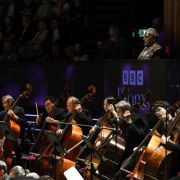
The silvery soubrette of Ellie Neate as Magda’s maid, Lisette, made an especially strong impression. Her teasing byplay with Juan Francisco Gatell as the poet Prunier offered further compensation for the lack of staging and line-up of music-stands. Under the experienced hand of Carlo Rizzi, the BBC SO and BBC Singers brought the waltz of the second act to a show-stopping climax. The singers were sometimes looking for time which Rizzi was not always willing to give them, especially at the ends of Acts 2 and 3, but doubtless the studio recording will find everyone on the same page.


Likewise, Iván Ayón-Rivas sounded every inch the impulsive tenor figure of Ruggero, with a youthful and unstinting top register, even if it looked as though Alaimo could have picked him up and put him in his pocket (which is effectively what Rambaldo does in the piece). La rondine stands or falls by its heroine, and Jaho has surely taken over from Angela Gheorghiu (as she did initially in 2013, at the Royal Opera) as the leading Magda of our day, the articulation of authentically Puccinian pathos further honed for our sympathy by her experience as Angelica and Butterfly. Even if this modern and more overtly tragic take on Magda fails to catch on, Jaho has left us with a compelling, definitive idea of what Puccini might have had in mind.