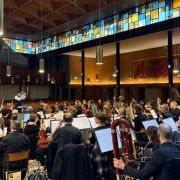
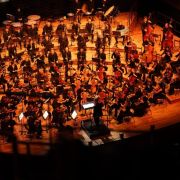
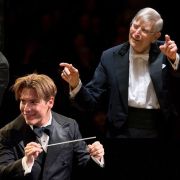
The Vienna Philharmonic, alongside conductor Tugan Sokhiev and violinist Hilary Hahn, is currently touring Europe with a Dvořák and Prokofiev programme. Their stop at the Elbphilharmonie neatly coincided with Dvořák’s birthday.

The first half opened with his Violin Concerto in A minor. The piece itself might not be full of flashy fireworks, but both soloist and orchestra clearly knew this music inside out. It felt as though an invisible string held the tension together, allowing Hahn’s musical phrasing to breathe naturally. Watching Hahn perform was a joy in itself: her bowing was broad, relaxed and remarkably efficient. The bow distribution and balance between up- and down-bows looked so effortless. What stood out most was Hahn’s dialogue with the wind section. Her tone slipped into the orchestral colours with a soft, singing quality that was a pure joy to hear. Moving straight from the first movement into the second gave it the seamless feel of a sweeping symphonic fantasy. By the third movement, things picked up with a crisp, rhythmic drive and a sharp, sparkling grain. As expected, the Vienna Philharmonic focused on providing a silky, sympathetic cushion. They didn’t set out to reinvent the piece or offer radical new insights, but it was a genuine sonic treat. The brief Bach Loure encore continued the lyrical and refined performance approach.


After the interval, Prokofiev’s Romeo and Juliet gave the orchestra a chance to show off the full power and range of its different sections. The dark energy released during Montagues and Capulets hit with incredible force, and by the time they reached Romeo at Juliet’s Grave, the sound turned heavy and rock-solid, like unshakeable stone. The brass led those heavy moments with a towering weight. But the orchestra shifted moods seamlessly. Young Juliet bounded along with a light, playful bounce, while Masks showed off the strings' incredible flexibility as they spun forward like a wheel that never stops turning.

In Dance, except for some unevenness audible from the string section, they nailed Prokofiev’s signature deadpan humour – dead-serious on the surface, but subtly quirky underneath. The farewell scene was pure theatre. A few solo violins pared the sound down into something intimate and quiet, almost like a private chamber piece shared between lovers. In the closing Death of Tybalt, they fully unleashed Prokofiev's relentless mechanical power, with low strings pounding out heavy, uninhibited blows over a dozen times.
Tugan Sokhiev was a blast to watch. He threw himself into the music, constantly making physical gestures – rolling his hands like turning wheels or mimicking violin strokes right in the air to shape the orchestra’s sound contours.


For the final encore, the Johann Strauss’, Éljen a Magyar felt entirely at home. The string section moved with elegance and flair, and as the piece drew to a close, the musicians even shouted out twice, a wonderfully spirited end to this compact evening.
This concert was promoted by DK Deutsche Klassik