German pianist Julius Asal has been making waves musically for some time now. Still under 30 but already developing a major reputation as a BBC New Generation Artist and current recipient of the Terence Judd-Hallé Award, he made his Sheffield debut in a concerto about which one might think it almost impossible to find anything fresh to say, Grieg’s Piano Concerto in A Minor. That Asal contrived to do so was not due to any virtuosic histrionics at the keyboard or interpretative affectations. Instead he presented the solo part with absolute lucidity of expression, the passage-work crystal clear and the melodic lines unfussily direct.

Turned to face conductor and orchestra when not in action, Asal seemed keen to make this a genuinely collaborative exploration of the work, and the Hallé responded with empathy, not just in the flute’s prominent solos but in the way the brass (notably the horns, who were excellent all evening) shaped their interjections to punctuate the music’s structure without any loss of delicacy. As an encore, Asal offered an improvisatory rumination of his own on the concerto’s key themes, opening up Grieg’s musical world to glimpses of Chopin and even Rachmaninov. He cuts a slight figure onstage, but the audience was left in no doubt of his ability to hold a concert hall’s attention in his hands.


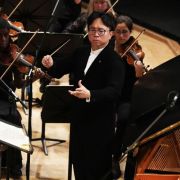
The Hallé and soloist were directed by British conductor Duncan Ward, “stepping in at very short notice”, as the programme note said, for the indisposed Lionel Bringuier. It clearly helped the evening’s music making that these forces had performed the exact same programme the night before in Manchester, which perhaps gave conductor and orchestra a chance to smooth out any rough edges to their reading of Sibelius’ ultimately heroic Symphony no. 2. This was an interesting performance, which didn’t linger at those moments where conductors are sometimes wont to. The slow movement, for instance, was on the fast side, the basses and cellos stepping briskly through their opening pizzicato passage, and the shrill woodwind and brass climax to the movement sounding agitated to the point of frenzy. Admittedly, the scherzo is marked Vivacissimo’, but not, surely, to the extent that phrasing becomes blurred. However, in many ways a reading of this symphony stands or falls by the way it treats the finale. Ward and his players pushed on through, which lessened the contrasts between the heroic brass fanfares and the interludes between them but rendered the movement more organic, less mechanical in its journey towards its inevitable climax.
If one might imagine that both the Grieg and Sibelius works were familiar enough for the orchestra to be able to play them in their sleep, the opening piece on the programme provided a real work-out for the players. The composition in question was Esa-Pekka Salonen’s rather mathematically (or perhaps one should say geometrically) inspired Helix. Salonen described this as “a celebratory and direct overture-like piece”, and the Hallé entered wholeheartedly into its ultimately spiralling, coruscating world. The work, though, is more than merely an intellectual exercise in which the tempo gradually increases but the music’s note values get correspondingly longer, so that the impression of increasing speed is both palpable and illusory. Performances like this prove that when the occasion demans, the Hallé can be a virtuoso showpiece ensemble, taking the journey from pastoral serenity to manic exuberance in their stride. Salonen might look back ruefully now on the effusive dedication to Valery Gergiev – something of a persona non grata in the West these days – but he surely would have been thrilled by this sparkling performance of his piece.