In 1966 Rudolf Nureyev staged La bella addormentata nel bosco (The Sleeping Beauty) for La Scala in Milan. He himself danced the Prince, alongside Carla Fracci as Aurora. With intermittent revivals, the production has remained a cornerstone of the company’s repertoire ever since, returning to the Milanese stage for the Christmas season.

The narrative device of Beauty is well known and rests on a familiar traditional theme: the revenge of the outcast. One need only think of Eris, barred from the wedding of Peleus and Thetis, who casts the apple of Discord, ultimately setting the Trojan War in motion; or of Venus in the tale of Cupid and Psyche, another story of sleep and suspended desire. Here, this figure takes shape in the evil Carabosse (vividly performed by Giorgia Sacher), excluded from the court celebration and casting the fatal spell of the spindle upon the infant princess.

As the curtain rises, stunning costumes and fabulous sets, iconically conceived by the stage genius Franca Squarciapino, draw us into the court of King Florestan XXIV. The fairies bestow their gifts upon the child: purity (a lyrical Vittoria Valerio); grace in dance (for which Nureyev assigns a pair, Marta Gerani and Linda Giubelli, an astonishing duo); fertility, with complex pizzicato steps on pointe (Gaia Andreanò); song and laughter, embodied by the brilliant Canary Fairy (Giordana Granata); and regality, by the energetic Fire Fairy (Martina Valentini). The Lilac Fairy variation, danced by Maria Celeste Losa, unfolds with beautifully extended lines.


The “true” Lilac Fairy is instead entrusted by Nureyev, in his attempt to restore Marius Petipa’s original intentions, to a non-dancing, mime role. Chiara Fiandra strips it of all naïveté, endowing it with a convincing, solid pragmatism.

From her very entrance, Alice Mariani commands the stage as Aurora, striking in yellow in the first act and beautifully matched with the warm tones of the court. She confirms her masterful artistry in the Rose Adagio, where every balance is secure and poised, and in her solo variation she displays remarkable control and precision, gently tracing the arc of the princess from shyness to youthful triumph.
The second act opens on a courtly group, as at the beginning of the third act, dancing a Versailles-style Baroque sequence: a trace of Petipa’s homage to the French court where ballet was born, later preserved and emphasised by Nureyev. A hunting game is organised, from which the Prince remains apart, sensitive and troubled. Navrin Turnbull, already shining at the end of last season as another Nureyev prince in Swan Lake, appears here delicate and profound, his refinement and technical brilliance met with acclaim. He captures Désiré’s tormented spirit, and in a long solo that unfolds like an open confession, a sustained description of his inner world, he reveals with clarity the tension between ideal and reality, alternating physical brilliance with pauses of intense introspection.

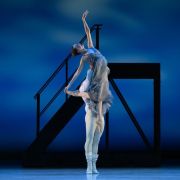
A group of green dryads invades the stage, accompanied by the Lilac Fairy and Aurora, now dressed in the customary lilac. The pas de deux between Mariani and Turnbull beautifully conveys their disembodied, suggested relationship and their reciprocal unreachability. Their variations are pure poetry: Aurora’s presence is so gentle, and Désiré’s enchantment so heartfelt, that by the end they are completely enamoured — and so are we. Their love would risk vanishing, were it not for the intervention of the Lilac Fairy, who takes the astonished Prince onto the dreamlike boat and finally leads him back to her. As they reunite at court, the spell is broken.


The third act is an explosion of festivity, marked by a vivid chromatic outburst. Marco Agostino shines in the demanding male variation of the Precious Stones, with its many pas de basque and rapid changes of direction so typical of Nureyev. The crossover with characters from other Perrault fairy tales is, as usual, among the elements most warmly received by the audience. Edward Cooper’s Bluebird is greeted with particular enthusiasm: his explosive jumps delight the public, alongside a charming Princess Florine danced by Camilla Cerulli. The Cats (Sabrina Solcia and Domenico Di Cristo), with a greater economy of arm gestures than in other versions, are feline, alert, and highly expressive. The whole finale, with the wedding pas de deux and the Mazurka, radiates joy and cohesion, sealing a very successful performance.

Two main strengths emerge, confirming La Scala as an ever more prominent presence on the international scene. First, the dancers are in excellent form: the principal roles are carefully shaped, and the ensemble passages are finely coordinated, even in demanding moments such as double turns and jumps. Second, the musical direction is outstanding. Kevin Rhodes gets everything exactly right; his conducting speaks of attentive care, close collaboration with the dancers, and deep knowledge of the score, reminding us how much music and dance gain in expressivity and impact when they fit together like a glove.