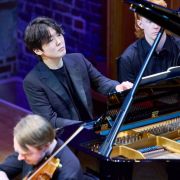
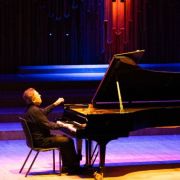
Some pianists are made for the stage. Yunchan Lim is decidedly not. After four years of hyperbole’s relentless pursuit, he remains ill at ease with concert rituals. Hands clasped boyishly in front of him, Lim surrenders to the applause – although he is not fazed. His allure lies in his humility, looking not for praise from below but to higher musical planes. As their 125th anniversary celebrations continue, Wigmore Hall’s message is clear: we are witnessing an extraordinary flowering of young pianistic talent, and Lim is leading the pack.

Schubert’s Piano Sonata no. 17 in D major, D.850, finds the composer in unusually high spirits. Written in 1825, in the Austrian spa town of Bad Gastein, natural beauty permeates the work. But flowing brooks this is not: instead, Lim charged the Allegro vivace with white-foamed rapids, vertiginous mountains and sweeping alpine vistas. Infusing the Wigmore’s Steinway with kinetic energy, this was a performance marked by sharpness of thought.


The second movement, headed Con moto, is one of Schubert’s most inspired. In Lim’s hands, the action was episodic: a living, breathing thing that glided with the wind, picking up whispers of bird song and half-remembered images. Under the midsummer’s gentle balm, Lim spread his wings and took us on his back. He served up the Scherzo with ebullience – all propulsive dotted rhythms, until sinking into the Trio’s meditative soundworld – but the concluding Rondo was left ambiguous. Its music box theme ached with the wistfulness of a tired soul. Even after the clouds had parted, returning to Lim’s world of childlike wonder, it was tinged with the burden of age.
If his Schubert is rooted in nature, the music of Alexander Scriabin courses through Lim’s blood. Approaching these three transitional sonatas as an unbroken suite, he produced a rapturous stream of emotion. The Second Sonata’s Andante burned with agitation, scarcely relieved by moonlit interjections. Recalling the nightmarish finale of Chopin’s own second sonata, the Presto was a raging moto perpetuo; Lim conjured apocalyptic visions of Sturm und Drang, rising inexorably to peaks of greatness.
He stormed into the Third Sonata, a notoriously complex work to grapple with. But Lim was equipped for the challenge: a Bachian awareness of line seemed fundamental to his approach, giving constant insight into the logic of every musical strand. Even when navigating the knottiest of textures, his contrapuntal ease was something to behold.


Lim blasted through the Scherzo’s compacted mania, melting tenderly into the Andante – Scriabin’s blissful dream. When pianist Elena Beckman-Shcherbina played this movement to the composer, he cried out: “Here the stars are singing!” Lim let its melodies soar, chromatically wandering inner parts giving way to sweeping arpeggios. Sound appeared to come not from his fingers, but simply to materialise from the piano’s bowels.
The Fourth Sonata brought us into the 20th century with wild, intoxicating colour. The Andante unfolded in one breath, a fantasy of weightless flight and Lim’s jazz-inflected runs. A daringly long pause overflowed into the Prestissimo volando, hurtling towards ecstatic release. Lim’s sound was terrifying: an explosive force, surging and unstoppable, with chords of Horowitzian power. Here, the stars did not so much sing, as they shattered.
Sometime after its publication, Scriabin wrote an accompanying poem. Predictably, it describes flight to a distant star: “Thinly veiled in transparent cloud / A star shines softly, far and lonely. / How beautiful! The azure secret / Of its radiance beckons, lulls me…” Lim’s secret remains elusive. But those who listen might find themselves under the glow of his rays.