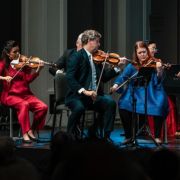
For Seattle audiences, James Ehnes is more than another internationally celebrated soloist dropping in for a guest appearance. He has described both the city and Benaroya Hall as places he thinks of as home. The previous evening, he had introduced the opening event of Seattle Chamber Music Society’s new season, the organization he leads as artistic director; now he was back as soloist in the Seattle Symphony’s first subscription concert of the season. Those back-to-back appearances are a good indication of how closely Ehnes is connected to the city’s musical life.

Those connections extend directly into the orchestra. Ehnes has appeared regularly with the Seattle Symphony and often invites individual members to perform at SCMS. Indeed, in Bruch’s First Violin Concerto, his rapport with the players under Xian Zhang often felt like chamber music on a larger scale, with soloist and ensemble listening closely and playing off each other throughout.


Bruch’s familiar score gave Ehnes room to draw on a wide range of his extraordinary resources as a violinist; for all its technical demands, he simply took them in stride. What stood out instead was his control of color, weight and intensity. His rich, full tone, supported by a generous vibrato, can recall an older school of violin playing, yet in his hands it felt entirely alive. Ehnes could darken the sound almost without limit in the lower register, then open it out into ecstatic high notes. He gave particular weight to Bruch’s great lyrical moments, lingering over them without tipping into sentimentality. In the Adagio, the solo and orchestral lines fused with especially moving force. He brought the same ear-opening attentiveness to the second theme of the finale.
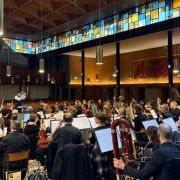
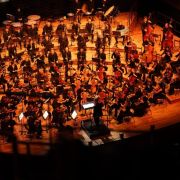
After intermission came the finest Seattle Symphony playing I have yet heard under Zhang, who has just launched her second season as Music Director. She treated Berlioz’s Symphonie fantastique as a music drama in five acts, alert to one of the signature features of its Romanticism: the sudden contrasts and almost jittery gear-shifting through which the music keeps changing emotional direction, while the recurring idée fixe gives those abrupt shifts an underlying narrative coherence. Again and again, extreme agitation is interrupted by moments of serenity.
From the outset of Rêveries – Passions, the music already inhabited a dream-state: the nervous agitation of the strings took on an almost erotic charge whenever it pressed against the idée fixe, while calmer episodes, with their flute-sweetened string lines, offered temporary refuge from that intensity.


In the ballroom scene, Zhang made the waltz dance with an energy that swept it through the room. Against the bustle of the ballroom, the recurrence of the idée fixe sounded all the more intrusive, a private obsession suddenly breaking through.
The long Scene in the Country altered the sense of space completely. The carefully positioned offstage oboe answered the English horn from a mysterious distance that gave Berlioz’s pastoral dialogue an added sense of suspense. As the movement unfolded, the distance grew increasingly unsettling, with the surrounding emptiness becoming part of the drama.
The March to the Scaffold had savage rhythmic bite and tremendous forward momentum, propelled by the quartet of timpanists and sardonic fanfares. The fleeting return of the idée fixe just before the fatal stroke hit home with grotesque pathos.
The Witches’ Sabbath naturally elicited the most extravagant range of hallucinatory detail and color. The entire orchestra cast Berlioz’s spell with genuinely spine-tingling effect, from the eerie offstage bell strokes and chilling squawks of the E flat clarinet to demonically growling lower strings and mock-solemn intonations in the brass. Zhang drove the music right to the edge of chaos, the final frenzy threatening at every moment to break loose altogether.