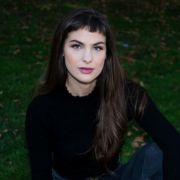
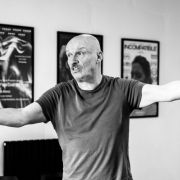
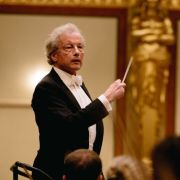
Confession: there are stretches of Der Rosenkavalier – particularly the Ochs–Mariandel pantomime in Act 3 – which to me can feel interminable. But take singer-actors like Peter Rose and Patricia Nolz, who can make the scene genuinely funny, and a conductor like Christian Thielemann who allows the dialogue to dictate the pace, it just slips by. Time, as the Marschallin sings, is indeed a strange thing. On the opening weekend of the Staatsoper Unter den Linden’s Festtage, there was so much cut and thrust to this revival that the performance finished a good 15 minutes ahead of schedule.

Since succeeding Daniel Barenboim as Generalmusikdirektor, Thielemann hasn’t actually conducted much opera here (it was, remember, a fairly hasty appointment following Barenboim’s resignation and schedules are planned years ahead). Thielemann conducting Strauss is always a red letter day, especially with an orchestra as refined as the Staatskapelle Berlin and a cast featuring two splendid young singers, so there was a festive, anticipatory air to proceedings.


The pit in the Staatsoper is incredibly deep so that you can’t see the conductor at all, although I was able to spot a monitor showing him working hard, generating boisterous energy from the orchestra but also balancing his forces with exceptional care so that voices were never overpowered. The sighing Staatskapelle strings at the close of Act 1 were achingly lachrymose. Thielemann indulged in a long pause before the Act 3 trio, almost teasing the audience with a ‘this is what you’ve all come for’ moment. And it was, indeed, heavenly.

The cast was led by Patricia Nolz, making an outstanding role debut as Octavian. Audiences in Vienna and Berlin will be familiar with her Cherubino, Octavian’s operatic cousin, but here we witness what she can do when Strauss allows the voice to open out. Her mezzo is cherry-toned and luscious, but the top has a glossy sheen many sopranos would envy. She acted the lovestruck teen of Act 1 – dreamily sketching the Marschallin’s portrait – but also navigated the character’s growth splendidly, as well as being a genuinely comic Mariandel, rural accent and all.
Julia Kleiter lacks the cream of the best Marschallins, but her tender tone was affecting, particularly in “Die Zeit, die ist ein sonderbar Ding” when she stepped onto the walkway over the pit, as if confiding her innermost feelings directly to the audience rather than to Octavian. By the end of Act 1, she knows the affair is over, tearing the portrait of her in half as the curtain descends. Her choked “Ja, ja” to Faninal at the end was barely whispered. Spinning silvery top notes, Nikola Hillebrand sang Sophie with bright-eyed innocence. When her eyes met Nolz’s after they sniffed the Persian attar on the silver rose, time truly stood still.


Peter Rose is a seasoned Baron Ochs, here not overly boorish but still comic. He clearly has iron lungs, dispatching the wordy dialogue with panache, and plumbed the depths at the end of Act 2 with profondo ease. Among the supporting cast, Andrés Moreno García did a lovely job as the Italian Singer, drawing the Marschallin’s other petitioners back into the room as well as a couple of stagehands who wander absent-mindedly onto the set.

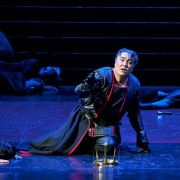
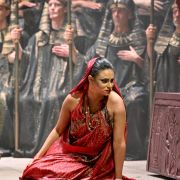
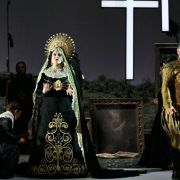
The action of André Heller’s production is faithful to the libretto, even if he updates the action from the 1740s to roughly the period of composition. The Marschallin’s boudoir is gaudily lit, rose petals sprinkled as breakfast rises through a trap door. A gold-suited Faninal flaunts his wealth, the Presentation of the Rose appearing to take place in the Secession Building, with guests admiring Gustav Klimt’s Beethoven Frieze. The “shabby inn” of Act 3 is exchanged for the Palmenhaus, where video projections of rat and spider silhouettes freak out a jumpy Ochs. And as the Marschallin goes off on Faninal’s arm, leaving Octavian and Sophie in each other’s arms, it’s all topped off with a gorgeous starfield. Job done. Cue tears.