Natalia Makarova’s La Bayadère was last performed by The Royal Ballet back in 2018 and is unlikely to return to London any time soon. Its place in company repertoires has become controversial with the more exotic elements of the story and characters well documented. Dutch National Ballet have recently offered a “renewed” and “adapted” version and next year Birmingham Royal Ballet will premiere a reimagined take set in Renaissance Venice. But what of Makarova's production with its close ties to the 1877 original? With its opulent costumes, bravura dancing and Kingdom of the Shades, Norwegian National Ballet’s opening night in Oslo was a strong argument for its place in any season, displaying ballet escapism at its best.

Of course, this was not the only reason for an expectant full house in Oslo. Without opportunity to dance La Bayadère at Covent Garden, Artistic Director Ingrid Lorentzen had flown in Marianela Núñez and Patricio Revé for just two performances. The pair dance the roles of lovers Nikiya and Solor, with Norwegian National Ballet principal, Melissa Hough, as Solor’s intended, Gamzatti, completing the enticing central trio.


The first act is packed with the bulk of the storytelling over three separate scenes, but it’s the dazzling, transporting designs (Pier Luigi Samaritani) that are most impactful. The glittering costumes (Yolanda Sonnabend), rich in detail for the High Brahmin (Vasilii Tkachenko) and the shimmering golds of the corps of temple dancers whose outfits audibly jingle and clatter as they fill the stage.
Ludwig Minkus’ score is urgent from the offset, capturing the swirling chaos of the fakirs preparing the fire. This quickly subsides to near silence for Nikiya’s regal entrance, framed perfectly on the stage at the top of a small staircase, her face covered by a white veil. Núñez is immediately commanding even in these first few slow and deliberate steps, her upper body exudes a soft serenity. Best of all is the chemistry with Revé. It is not gentle or polite, their pas de deux is fuelled with intent and passion and all over too soon.

Meanwhile Hough’s Gamzatti is contrasting in her confident stalking of the stage. She is spiky and stern, dressed in sumptuous golds and yellows with a bejewelled headdress, undeniably threatened by Núñez’s Nikiya. The physicality in their scrap feels authentically dramatic.
It’s Gamzatti and Solor’s engagement celebration where a little more rehearsal is required. There is another colourful backdrop from Samaritani but there is some raggedness in the ranks of the corps de ballet. The two foursomes in the pas d’action lack synchronicity and the demanding choreography sits awkwardly at times.

Revé does an excellent job here as the sullen betrothed, he is outwardly unhappy, frustrated and never once shares a look with Hough’s Gamzatti. In the solos he is neat and compact, not a high jumper, but silky smooth in his jumps and tours. There’s still a sense he’s only just getting started.
Gamzatti gets all her big moments here. Hough approaches her solo with care and she is secure and strong in her core. She digs deep during the arabesque balances and shows control and poise in the many attitude turns.


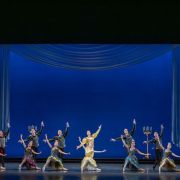
It’s Act 2 that’s worth the ticket price alone as we enter the Kingdom of the Shades in Solor’s hallucination. The nervy corps from earlier are now finely drilled for the Shades iconic entrance and those 39 arabesques. It’s as ethereal and serene as it should be, there’s an unintrusive misty haze across the stage suggestive of Solor’s opium dream. The challenge isn’t even over after this, as they bourrée smoothly back and forth into new formations. There are extended balances, and even a développé performed by the 24 dancers all in unison, not a wobble or rogue angle to ruin the picture-perfect sight.
The momentum continues, with Núñez and Revé warmed up now and ready to hit more explosive territory. Núñez is ghostly in white, her glorious piqué turns which speed up into a blur, the urgent hops across the stage as the score swells. Revé has no problems either, his energy shifts, his love for Nikiya is clear, his jumps more uninhibited, his cabrioles spring with an easy height. Breathless stuff, and the audience responds enthusiastically.

Act 3 is as handsome as those prior, a return to the temple and a thrilling addition from Guiseppe Ventura’s vibrantly danced Bronze Idol, before Nikiya and Solor are reunited in eternal love.
Makarova’s production has never looked finer, and as she took an emotional curtain call with the cast, the message feels clear: such classics of the ballet repertoire surely cannot be lost and the greatest dancers in the world still want to dance it. La Bayadère remains bright and fantastical and showcases the full depth of this impressive company. The opening night audience in Oslo were thrilled with all it had to offer.