If we follow the argument that opera should ask the difficult questions and be a mirror on society, then Dutch National Opera’s latest offering of Mieczysław Weinberg’s The Passenger is a timely addition to its canon in a 2024 production by Tobias Kratzer, previously seen at the Bayerische Staatsoper. Based on the memoir of Auschwitz-survivor Zofia Posmysz’s (1962), it approaches the Second World War narrative from a slightly unexpected angle. The novel, prompted by an encounter in Paris where Posmysz mistakenly thinks she recognizes the voice of her former SS guard, finds guilt at its core. In stark contrast to other memoirs at that time which focus on the survivor – think Primo Levi’s If This is a Man (1947) and Viktor Frankl’s Man’s Search for Meaning (1946) – Posmysz places the camp guard centre-stage.

The subject of the Nazi occupation runs deep in the Dutch psyche. With both the National Holocaust Names Monument and the Jewish Museum just a stone’s throw away, and with Daan Schuurmans’ The Story of the Netherlands currently addressing this moment in time on prime-time Dutch television, the addition of Weinberg’s first opera into DNO’s repertoire seems almost cathartic for a nation more akin to holding such matters close to its chest.


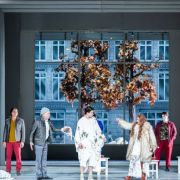
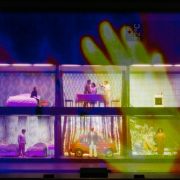
Building on the work’s first, fully-staged performance in 2010 (at the Bregenz Festival), Kratzer’s version, now in the hands of revival director Andreas Weirich, deliberately avoids explicit depictions of camp atrocities, believing that indirect representation leaves more room for imagination and emotion. Instead, it focuses on Lisa’s memory working as an SS guard in Auschwitz, her interactions at that time with two prisoners – Marta and her fiancé Tadeusz who, when he refuses to play the requested violin waltz, is brutally killed – and the banality of Lisa’s relationship with her career-diplomat husband Walter as they emigrate to South America, hoping to leave behind the horrors and secrets of post-war Germany. The solution is something of a break from Weinberg’s original explicit intentions. In its place, Rainer Sellmaier’s set juxtaposes Act 1’s opulent ocean-liner with Act 2’s vast dining room, laden with immaculately set tables.

Weinberg and his librettist Alexander Medvedev show little respect for Lisa, played here by Jenny Carlstedt, mocking her arrival on stage with dark, sustained chords while chiming bells of doom articulate her shock at hearing Marta’s voice. Even Lisa’s assumed acts of kindness towards Marta (despite ordering her fiancé’s death) are mocked by exquisite cello lamentations while solo violin meanderings provide the backdrop for female SS guards calling out prisoner numbers. Lisa is far from the beautiful fairy Walter believes her to be. Tormented, deluded, emotionally insecure and unpredictable, she remains haunted by her mysterious past.

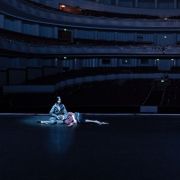
Any hint of sympathy is instead transferred to ‘old Lisa’ played by German actress Sybille Maris Dordel. Age, it seems, has mellowed the former SS guard who spends much of the first act shadowing her younger self while clutching an urn full of her self-centred, dead husband’s ashes. Instead, it is Marta, performed by the fabulous Sylvia D’Eramo, who gains our full respect as she lays her soul bare on the Amsterdam stage. The very fragility of her life is magnified as she stands with fellow, female prisoners, some seated, others with their backs to the audience, pleading to “Jesus our Christ” for help. Margarita Nekrasova’s heart-wrenching Russian prayer captured the mood perfectly, as did the DNO Chorus’ ghostly “Black wall of death”.


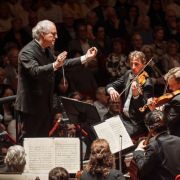
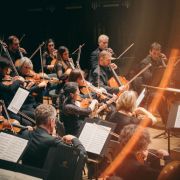
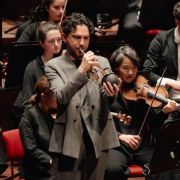
The ultimate hero of the evening was Weinberg’s score and his exquisite storytelling in the hands of young British conductor Adam Hickox, making his DNO debut. Clear, precise, expressive gestures brought this neglected score to life as Hickox slipped seamlessly between genres, the Netherlands Philharmonic Orchestra repaying his generosity of spirit with playing of the finest order. As clarinets, saxes and brushed snares depicted a Weill-inspired 1930s German cabaret, double basses were visibly grooving on their stools. Bravo also to the baritone horn’s quirky marching band solo, and the muted trumpet’s repeated top A flats. The impassioned Bach Chaconne – Tadeusz’s defiant protest – from Dutch violinist Niek Baar, shadowed with remarkable accuracy by Gyula Orendt, provided the emotional climax.
This production has the power to transcend normal discourse and to transfix. While some may wish for a more explicit portrayal of the horrors, after 42 years lying dormant, perhaps, the very fact that this controversial work is staged at all is enough. Let us hope that Weinberg’s message does not fall on silent ears. The line “What will become of us?” is as relevant now as when Weinberg penned it some 60 years ago.