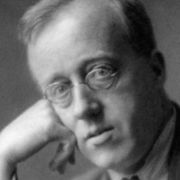


The English Choral tradition is a wonderful thing. While Andy Burnham may think otherwise – mentioning choirs only once in ‘Turn it Up’, the UK Government’s music plan – the recent centenary of BBC Radio’s weekly Evensong broadcast proves the country’s real ardour. It was a shame then that this Trinity College Cambridge celebration of such a vital musical ecosystem seemed, at times, diffident in its approach. At others, it found itself exactly where it wanted to be: the finale, Vaughan Williams’ Five Mystical Songs, was an enchanting display of sensitivity from baritone Roderick Williams.

Subtly colouring the words of Herbert’s spiritual poems, Williams’ singing was a masterclass in intimate storytelling, as choir, quintet and piano disappeared on stage behind him. From the uplifting Easter to the cathartic and conversational Love Bade me Welcome, Williams illuminated the verse with fresh insight and a technical ease that blossomed in the Chapel’s wide acoustic. It was only in I got me flowers, and Antiphon, where a civility crept in, as choir and soloist seemed well protected from any emotional excess.


Throughout, this elegance of choral sound yielded admirable results in the solo efforts of Schola Cantorum, a choir drawn from the students of Cambridge University. Purcell’s Hear my Prayer was artfully balanced, and the polyphonic entries clearly articulated across the choir, facilitating well the image of a crowd calling out for God’s mercy. Clarity of text and line yielded a sweet, inviting sound – beautifully diaphanous in the plainsong accompaniment to Love Bade Me Welcome – but perhaps this surgical focus prevented the singers from becoming quite as involved in the music as they may have liked.
While beautifully sung, Mozart’s Ave Verum Corpus never seemed to reach its inner, tragic, core. It felt as if the choir never fully bared their teeth, unable to hold focus during moments of limelight in the Five Mystical Songs, or to realise the sumptuous indulgence required in Fauré’s Cantique de Jean Racine.
The string based Celoniatus Ensemble faced the opposite difficulty. An ensemble with a wide sonorous palette, the string quintet moved from the full-bodied vibrato of Fauré to the gauzy, pastoral landscape of Holst’s St Paul’s Suite. Here, they found a bucolic dance-like atmosphere, playing with a twinkle in the eye matched by Williams in his rendition of the Foggy Foggy Dew.
The colour they struggled to find was the translucence required for the opening arrangements of Purcell songs. Instead, the trio of songs (If music be the food of love, Ah! How Sweet, and Music for a While) failed to make an impact in the Chapel, despite Williams’ warm and sophisticated storytelling. Instead, the arrangements (of Williams’ own devising) seemed soft-edged and bloated, unable to conjure an appropriate sense of fleet-footedness. Under the acoustic, Celoniatus were unable to escape a muddy sound, constricting Williams’ range of expression as he found himself struggling to cut through the ensemble at times.


Their solo performance of Bach’s Sonata in E major for Violin, BWV 1016, faced similar issues, despite Harriet Mackenzie’s ability to fill the Chapel with elegiac character. Rather, the vulnerable interplay between violin and harpsichord right-hand (in the original) was lost in the oddly swollen arrangement for quintet, interrupting moments of agonising Sehnsucht.
With all performing forces coming together in the final Five Mystical Songs, the evening found its raison d’ être, cementing, despite Mr Burnham’s protestations, the value of collaborative singing. For a concert promoting the charity ‘Music in Action’, which provides access to musical education for disadvantaged children, there could not have been a more reaffirming ending.