In these straitened times for regional ensembles, a new “international” opera company outside the capital is something to be applauded. Oxford International Opera boasts Sir Bryn Terfel as its artistic director – which may be stretching the truth for marketing purposes, but at least it gives them access to his little black book of opera singer pals. Its inaugural production offers the Welsh knight the chance to reprise one of his classic roles: Scarpia, the corrupt Chief of Police in Puccini’s Tosca. And he’s brought along Carmen Giannattasio – criminally underemployed at Covent Garden – and Saimir Pirgu for the ride.

Alas, unlike the execution squad that polishes off Cavaradossi, this opening salvo was firing blanks. A new company requires firm leadership, a clear sense of direction. Sadly, that was lacking here, both in terms of the musical and the stage direction.


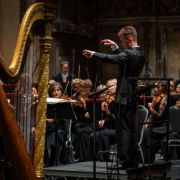
There is no real pit in Oxford’s New Theatre and this amplified the Oxford Philharmonic’s lack of finesse, exposing smudged entries and a few cracked notes. Music Director Marios Papadopoulos did not remotely follow his singers; indeed, he showed scant regard for them all evening, head down, guiding his charges – slowly – through the score. Never has the Act 3 dawn taken so long, Puccini as Parsifal.

There is nothing inherently wrong with Anthony Lamble’s minimalist, modernist set – black with a single piece of stage furniture for each act – but P Burton-Morgan’s direction was so light touch that it seemed the singers were largely left to their own devices, importing their characters from past productions. But singers need direction, or at least they need reining in, otherwise you get Terfel performing Scarpia like a pantomime villain, playing to the gallery (with considerable success).
In the Te Deum, the chorus are plonked on stage looking entirely unsure why they are there. Minor misreadings of the libretto irritate. “Give me my paints,” demands Cavaradossi, but the Sacristan offers a selection of brushes. “Why was the door locked?” quizzes a suspicious Tosca. It wasn’t.
The only evidence of directorial ideas are a sudden flashing of red lights at moments of peril, a shepherd boy with a balloon (why?) and, more successfully, the on-stage wandering of the clarinettist during “E lucevan le stelle”, a little like the cor anglais player in Act 3 of the Met Opera’s new Tristan und Isolde.


The casting was duly impressive, although the performances were variable. Terfel has hinted that this will be his final stage outing as Scarpia. He still has tremendous charisma – a chilling villain – but he roared his way through much of the music, his vibrato cavernously wide at times. Sion Goronwy played the Sacristan for laughs, Peter Van Hulle’s Spoletta was an oily henchman. Blaise Malaba’s solid Sciarrone was more understated. Pirgu sang an ardent Cavaradossi, his phrasing a little clipped in “Recondita armonia” but his “Vittoria” rang out and he sang a very decent “E lucevan le stelle”.

Giannattasio’s Tosca was coquettish in Act 1, even if she was costumed in a red trouser suit like an airline stewardess. She was waspish in her exchanges with Scarpia – landing a perfect hit when hurling the fan straight on the nose of the Mary Magdalene portrait. Her vivid soprano has just the right balance between cream and acidity, culminating in a passionate “Vissi d’arte”, a really classy bit of singing, and a tender “O dolci mani” duet with Pirgu in Act 3. Her Tosca made the trip to Oxford worthwhile.