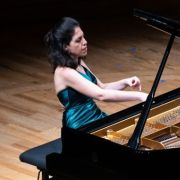
“Martha Argerich plays Beethoven”. Those four words were enough to fill the Royal Albert Hall to bursting, the first of the BBC Proms to sell out when public booking opened back in May. At 85, the veteran pianist shows no sign of slowing down. Her concerto repertoire may be contracting – it was never that broad in any case – but her schedule is busier than several pianists half her age. Argerich’s touch is still exquisite, her clarity of line focused, her pedalling light.

Beethoven’s Second Piano Concerto is far from his magisterial Fourth and Fifth, which Argerich does not play. It is almost Mozartian in temperament and scale. Indeed, it was composed while Mozart was still alive, but it wasn’t published until 1801, after the C major concerto, and was thus designated No.2. Tapping out the rhythm on her knee during the orchestral tutti, then flicking back her mane of silver hair, Argerich tucked into Beethoven’s crisp, contrapuntal lines, before an introspective first movement cadenza and a reflective Largo filled with a sense of repose.


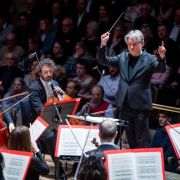
Many of Argerich’s conductor colleagues – Daniel Barenboim, Zubin Mehta – are winding down their careers these days. Among the new generation of trusted collaborators, she has built up an evident rapport with Lahav Shani, often sharing a platform with him. Making his Proms debut, he and the Munich Philharmonic proved admirable foils for Argerich, happy to supply the featherbed strings in the slow movement, alert to her fleet-fingered Rondo.
Looking bemused by the scale of the ovation that faced her, she and Shani further demonstrated their bond in a scintillating four-hands encore of Le Jardin féerique from Ravel’s Mother Goose, Argerich rippling gliassandos with expressive flourishes.

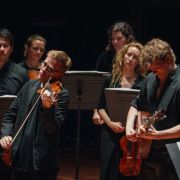
Shani officially takes up his role as the Munich Phil’s Chief Conductor later this month, although he’s been its de facto leader since his appointment was announced three years ago, after Valery Gergiev was ejected following his failure to condemn Russia’s invasion of Ukraine. They clearly work well together. Framing the Beethoven, where the strings were pared down to classical proportions, the orchestra was at full strength for Louise Farrenc’s Overture no. 2 in E flat major and Brahms’ Fourth Symphony.
Farrenc’s overture was given a lively rendition, strong in its declamatory statements, but nimble in the quicksilver passages. The Brahms was… portly. Shani allowed time to breathe in the sighing opening Allegro non troppo – emphasis on the non troppo – but with such a large string contingent, textures felt clogged, not always allowing the Munich woodwinds to shine. A wide horn vibrato marred the opening of the Andante moderato, and the animated central section lumbered. The Allegro giocoso had punch though and the finale, a scholarly passacaglia, was earnestly dispatched.


For their encore, Brahms in less scowling mode, a rollicking rendition of the Hungarian Dance no. 5, the Munich Phil kicking up their heels in the bierkeller.