Composed in Paris more than three decades after he laid down his operatic pen, Rossini’s Petite messe solennelle was described by its composer as “the last of my péchés de vieillesse" (sins of old age). But once an operatic composer, always an operatic composer. Neither petite nor particularly solemn, the mass bursts with jaunty rhythms and secular tunefulness. Perhaps that’s why Jakob Lehmann and the Monteverdi Choir, performing within the distressed walls of Alexandra Palace’s shabby chic theatre, decided to unceremoniously insert an interval after the Gloria. Sacré bleu!


Rossini himself acknowledged the work’s theatricality, humbly addressing God on the final page of his autograph manuscript. “Have I just written sacred music, or rather, sacrilegious music?” he wrote. “I was born for opera buffa, as you well know. Not much technique, a little bit of heart, that's all.”
Written in 1863, the mass was originally scored for two pianos and harmonium, accompanying a choir of twelve. Rossini preferred this chamber version and only orchestrated it later because he feared that if he didn’t, then others would do so after his death. As it turns out, he never heard the orchestral version, largely because he was obstructed by the papal ban on women singing in church. Its premiere didn’t take place until February 1869, three months after Rossini died.

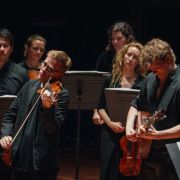
With the period instrument forces of the Orchestre Révolutionnaire et Romantique, this performance vividly recreated the sound world Rossini may have heard had he lived long enough to hear it. The scoring has the distinct whiff of Berlioz (who died in March 1869) including an ophicleide – displaying a rustic rasp here – and a throaty trio of trombones. Lehmann’s layout was imaginative, the double basses split at the extreme wings of the stage, the two harps for the Gloria placed either side of the conductor at the very front.


Lehmann drew an exciting performance, the clean attack of both the ORR and the 41-strong Monteverdi Choir quite thrilling. Raucous horns and belligerent timpani contributed to a tremendous climax to the Gloria, the choir in stirring voice. The sombre brass of the Prélude religieux – where Rossini does meet the “solemn” descriptor – framed a lengthy chamber organ interlude (William Whitehead) before a reflective Sanctus.

There’s more than a hint of the opera house in Rossini’s writing for his four soloists. With a wide vibrato, tenor Petr Nekoranec swung into the Domine Deus with carefree swagger. Lyric soprano Robyn Allegra Parton was at her best in the lilting O salutaris Hostia, pearly top notes beautifully placed. Bogdan Taloș’ sepulchral bass added welcome gravitas, but Natalie Lewis was the standout, her mezzo strong and dramatic, delivering a fervent Agnus Dei to close the performance.
Next door, a rave was taking place in Ally Pally’s Great Hall. The decibels of the Monteverdi’s Rossini may not have been as loud, but I can’t imagine it was any less bracing.