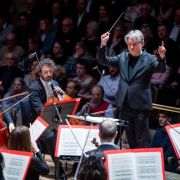
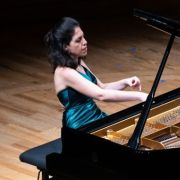
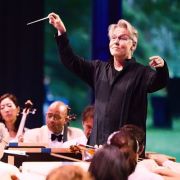
Nearly three decades separate Rachmaninov’s Second Symphony from his Rhapsody on a Theme of Paganini. If the former unfolds in broad Romantic spans, the latter is tighter, more mercurial and more sharply etched. They made a revealing pairing at Symphony Hall, with Andris Nelsons conducting the Boston Symphony Orchestra and frequent guest Seong-Jin Cho joining them.

From the outset, the ease with which Cho moved from refinement to bite was striking: finely drawn, subtly shaded passages acquired a harder edge almost instantaneously with their clarity intact. Even in the most dazzling moments, his virtuosity never called attention to itself. Rachmaninov’s often transparent scoring encouraged a constantly shifting dialogue with individual instruments and sections, sensitively coordinated by Nelsons without allowing the piano to dominate.


As the work moved into its darker central regions, the sinister connotations of the Dies irae were initially held in reserve, becoming increasingly diabolical as the music progressed. The pianist brought a different palette to the more atmospheric variations. The famous eighteenth had an unexpected simplicity, its lyrical expansion integrated into the surrounding structure rather than treated as the work’s obligatory emotional climax. The final sequence shifted the emphasis again, becoming more incisive and propulsive. Wit, rhythmic precision and sharp changes of accent mattered as much as sheer brilliance, giving the closing pages unusual definition.
For his single encore, Cho returned to the composer with whom his career has been closely associated, offering Chopin’s Waltz No. 19 in A minor, Op. posth., with quiet elegance and understated melancholy.
After the interval, Nelsons gave Rachmaninov’s Second Symphony ample breadth while keeping its sonority remarkably lean, even with eight double basses in the ensemble. In the first movement, the lyrical second subject seemed to grow naturally out of the somber opening. The ensuing scherzo tightened the pulse: rhythms were exact, articulation clean, and its drive sustained without relying on sheer volume. As in the Rhapsody, Nelsons gave the Dies irae sufficient weight without unnecessarily foregrounding it.


Some of the evening’s finest orchestral playing came in the Adagio. William R. Hudgins’s clarinet solo unfolded with poise and an unforced singing quality, while the woodwind writing throughout was handled with equal finesse. Nelsons gave the movement plenty of space, building its climaxes with intensity but without excess. However, as in the expansive first movement, a certain sense of longueur was not entirely avoided. The finale had plenty of energy, with earlier themes reintroduced with particular delicacy before the work reached its culmination. Their return felt less like a retrospective summing-up than part of the movement’s forward momentum. The performance remained unsentimental, with the conductor favoring continuity over rhetorical display. There was, too, a palpable sense of commitment from the orchestra, whose alert, responsive playing lent particular resonance to this early concert of Nelsons’s final season as music director.