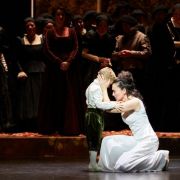
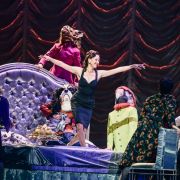
Glyndebourne’s Autumn Season opened with a very fine re-animation of the production of The Marriage of Figaro first mounted at the 2025 Festival. It was the 609th staging of Le nozze di Figaro – let’s not be coy about the title – and marked the continuation of a long-standing love affair between this joyous work and its home on these islands. Revival director James Hurley revelled in the broad sweep and fine details of Mariame Clément’s account of her day-trip to Castle Almaviva, moving at pace where the narrative is at the mercy of time, and clearly marking out the space required for the enactment of human passions. It was an approach that had been closely mapped with the conductor Bertie Baigent so that the Glyndebourne Sinfonia graphically illustrated Anna-Marie Sullivan’s movements for the knock-about and the intrigue, and generously supported the excellent performances of the singers.


Clément’s impressive production is largely faithful to the opera buffa label that Mozart and Da Ponte gave to the work. The high-pitched farce was abundant but not excessive; the visual gags well-conceived and knowingly executed; cloak-and-mask intrigue was inventive to the point of referencing Little Red Riding-Hood. As to the darker elements of the narrative, no punches were pulled. Indeed, the characterisation of the Count is not that of a sex-pest philanderer but a serial perpetrator of gross sexual and domestic abuse: he grabs the Countess by the throat, not once but twice in quick succession. That scene, potent and disturbing though it is, seems to me to be the only mis-step in Clément’s conception; it fits very uneasily with other aspects of the Count’s character, and, in a work where so much of the story is encoded in the music, there is nothing in the score to support it.

Julia Hansen’s design is simply magnificent; it is the main thing that will draw me back to the production. She has raised the revolving stage concept to a new height; not only does it effectively serve Clément’s narrative, in itself it is an arresting sight. It has more doors than Bluebeard’s Castle but there are no grisly secrets behind them. Instead, they provide one of the means by which the Chorus enacts its high-class contribution to the production. Hansen’s costumes are a rich collection of fine lines, beautifully-cut contours and sumptuous colours. They luxuriated, as did everything the production, in Paule Constable’s lighting array, which added its own adjective to the proceedings.

Those proceedings came courtesy of a fine cast doing great service to Clément’s vision and proving themselves to be budding Mozartians. Three of the leads were making their house debuts: Jasurbek Khaydarov (Figaro), Madeline Boreham (Countess Almaviva) and Anton Beliaev (Count Almaviva). Khaydarov’s “Non più andrai” was a little underpowered but he grew admirably into his role as titular schemer. As Susanna, Henna Mun, initially pencilled-in to sing Barbarina, has a delightfully creamy tone which, after a slow start, was fully in flight by the closing pages where “Deh vieni, non tardar” soared majestically. At her first entry Boreham invoked “Porgi amor” with aristocratic elegance; later, “Dove sono” was achingly anguished. She was also a touchingly doting mother. Clément gives her a daughter, a thickening of the plot she does not follow through in her portrayal of the Count. As the malignant grit in the oyster Beliaev’s feudal lord on the skids wasn’t dark enough, but in “Vedrò, mentr’io sospiro” he gave a glimpse of what the future may hold for him.


Former Jerwood Artist Rachel Roper enjoyed herself as Cherubino, coyly reciting his cavatina but there was little indication of testosterone. Another house debutant was Biqing Zhang. She and the remainder of the characters at the castle had clearly accosted Clément to give hyped-up accounts of their role in the intrigue; the visitor obligingly took them at their word. There is that statue in the garden about which everyone will have an opinion; mine is that it is just a statue. The denouement was very effectively staged and the ensemble gloriously rendered. However, it would be a mistake to deduce that all’s well that seemingly ends that way; the Count is still on the loose and, as we know from Scarlett O’Hara, that tomorrow is another day.