When entering the auditorium of the Royal Opera House to the sight of an image projected onto the safety curtain, an image which proclaims that Duty, Love, Mercy and Courtesy constitute “The Only Road”, one is tempted to expect a production of absolutist morality, possibly religious in character. So, when the curtain rises and the first people to appear are dressed in costumes associated with doctrinaire puritanism, that temptation solidifies into cast-iron certainty. However, after three and a half hours, that certainty was dissolved by an affectingly nuanced account of one of Handel’s masterpieces, a retelling that does indeed explore duty, love, mercy and courtesy, but does so in a style that confounds expectations. The moral messages are neither life-lessons nor the dictates of a theocratic dystopia.

Richard Jones’ 2022 production was engagingly revived by Sarah Fahie. It is built around an understanding that the story is a pre-modern version of magical-realism. Anthony McDonald’s design features a well-conceived array of tableaux-vivant, animated friezes and choreographed sequences which very effectively counterpoints the static nature of da capo arias. Lucy Carter’s lighting adds warmth to the enactment of passion, and watch-tower brightness to make-believe anger and outrage. David Bates’ purposeful conducting ensured that the orchestra gave solid support to the singers. Handel’s scoring doesn’t give many opportunities for grandstanding but the sound was generally rich and luminous, except for a few horn smudges in Act 3.


Leading a strong cast, most of whom were reprising their roles, was Lisette Oropesa as the eponymous sorceress. It was announced that she had been accosted by a cold, but it had clearly been wrestled into submission because she was in excellent form. One would expect a witch-queen, an early-adopter of Coco Chanel’s dress-code, to be the centre of attention and Oropesa’s tone, phrasing and articulation matched that expectation.

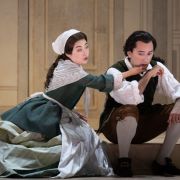
Mary Bevan’s Morgana gave her sister a good run for her money; she acted and sang as though either brought up on a different part of the island, or had attended a different finishing school. As the other parties in the love-matrix, Emily D'Angelo’s Ruggiero and Beth Taylor’s Bradamante earned their place in the plaudits with fine singing and acting. The former had a lot of work to do in the plot but never wavered in the mental gymnastics with both his loves; the latter very knowingly cold-shouldered Morgana’s randy intentions. Ru Charlesworth’s Oronte was not really a steward since his duties included that of gardener, pouring out his angst in a potting-shed, which also functioned as his man-cave in which is stored an arsenal, the tools used to destroy Alcina’s vaporiser.

I marked down Edward Grint’s Atlante as a potential witch-burner, but he turned out to be just a copper clapping Alcina in irons and doing so with relish. His addiction to testosterone was in marked contrast to the adolescent devotion of Thomas Mayes’ Oberto in the search for his bewitched father. Mayes is a gifted singer and a promising actor. His finest moment was during his first aria in which Fahie synchronised his steps with those of his father, in the form of a lion, moving in the shadows: duty and love?


Those who attended just for the show-stoppers would not have been disappointed; Bevan’s “Tornami a vagheggiar” and Oropesa’s “Ombre pallide” and “Ah! mio cor!” were the pick of a crop of good performances. Of several arresting visual treats the most striking two were particularly fascinating. One of the captives was a spaniel to whom was assigned the role of Alcina’s favourite, signalled by being allowed to be on the queen-sized bed – the seat of power – with her mistress. The staging of D'Angelo’s soulful rendition of “Verdi prati” was one of the tableaux-vivant, in a suitably verdant setting dominated by incongruously giant bonsai. Here was the true heart of the production. Ruggiero knows that everything will lose its charm but for a brief moment the strictures of duty, love, mercy and courtesy can take second place to the enchantment of the hour – or three and a half.
This review has been amended to reattribute “Ombre pallide” to Alcina (rather than Morgana).