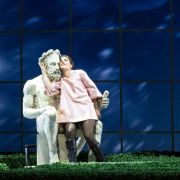
The gods, in classical Greek literature, make fools of us all. And of each other, if Francesco Buti’s 1662 libretto for Ercole amante (Hercules in Love) is anything to go by. It’s pretty irreverent about its divine characters and very irreverent indeed about the demi-god Hercules, whose glory days are well past and is now in thrall to his own desires, an ineffectual plaything of Venus.

The libretto was written for Francesco Cavalli, but that’s not the version now playing at the Opéra Bastille. Rather, we’re seeing the 1707 remake by Cavalli’s fellow Venetian and sometime pupil Antonia Bembo, who had fled her homeland some thirty years earlier to escape a violent husband – the parallels with Hercules as portrayed in the opera are no coincidence – and arrived in France where she was warmly welcomed at the court of Louis XIV (another powerful man whose glory days were well behind him). Bembo’s long-lost score showed up at auction in 1937, and today’s interest in women composers makes this first Paris staging quite the event.

The story is straightforward enough. Egged on by Venus, Hercules wishes to ditch his wife Deianira and marry their son Hillo’s fiancée Iole, whose father Eutyro has been killed by Hercules. Juno is outraged and vows to put a stop to proceedings, in service of which she recruits Neptune, the Grace Pasithea and Sleep. Venus, for her part, summons up Mercury to rewaken Hercules at a critical moment. Suitably daft Baroque shenanigans result.

Director-designer Netia Jones goes quirky with a capital Q. Costumes are designed for fun rather than coherence to any period, starting with the chorus of flunkeys whose powder and wigs over plain black frock coat and stockings reminded me of Playmobil figurines. Venus’ pink outfit is gloriously tacky, set off against Juno’s classier affair; Hercules’ pot belly has to be restrained by control underwear beneath his fencing outfit; Neptune’s fluorescent green scuba diver’s drysuit and its assembly of pipes is a sight for sore eyes (as is what appears to be a giant lobster pot with which he rescues Hillo). The domain of Sleep is a superb confection of scaffolding, lounging bodies and video, there is much fencing (with animations of Greco-Roman wrestling in the background) and badminton (with many shuttlecocks). When Hercules is eventually subsumed into Heaven to be married to Beauty, his bride is a Barbie-doll creature who moves mechanically in a way reminiscent of Olympia from Les Contes d’Hoffmann. I’m not normally a fan of such a kitsch aesthetic, but Jones pulls it off with such humour and panache that she completely won me over.

The vocal stand-off between Juno and Venus was wonderfully sung by Julie Fuchs and Sandrine Piau. Juno is a great part – far from the whingeing harridan frequently portrayed, she’s clearly the boss of the show – and Fuchs was properly regal in demeanour allied to a beauty of voice every bit the equal of Piau’s glittering soprano. Deepa Johnny provided fine support as the wronged wife Deianira, and Ana Vieira Leite shone with her in a wonderful trio in the second half, together with Marcel Beekman, who stole the show in the comic relief character of Deianira’s servant Licco – who gets all the best lines and brought the house down at regular intervals. However, I was disappointed by Andreas Wolf in the title role: the vocal line goes very low and significant portions of it need a basso profondo rather than a bass-baritone; Wolf simply wasn’t able to project authority so low in his register.

Bembo’s music is plenty charming enough to make for a fine evening of opera. But I can’t hide the fact that I found it completely unmemorable. The morning after, there’s not a single aria or snatch of melody that has stuck in my head. On the other hand, I appreciated the verve with which Leonardo García-Alarcón – whose project this is – and Cappella Mediterranea threw themselves into the score, and the variety of timbres lent by harps and various continuo and percussion instruments. But it’s a big ask for this music to be played from a huge pit in such a big house, and loss of clarity inevitably resulted. A hat tip also goes to the Chœur de Chambre de Namur, who sang with precision and energy and obviously enjoyed the various capers demanded of them by Jones.

The first half seemed slow, with a great deal of setting up of the story, but the show came to life in the second, starting with Alasdair Kent’s heart-wrenching lament as Hillo, imprisoned in his tower above the ocean, and his rescue by an excellently gravelly Alex Rosen as Neptune. The emotions became tauter, the definition between tragedy, comic interludes and song-and-dance better defined. Jones’ staging continued to spring entertaining surprises and, by the end, this opera felt like a winner.