At first sight, Trouble in Tahiti and The Seven Deadly Sins bear little resemblance. The languages are different, the musical styles are (literally) an ocean apart, they are separated in time by two decades and a world war. Leonard Bernstein’s acid irony contrasts with Kurt Weill and Bertolt Brecht’s fury at human injustice. Tahiti is set in middle class gentility where Deadly Sins depicts hustle on the breadline.

Opera Prelude’s double bill at Holland Park, however, highlighted how similar these works can be. Both feature a pair of protagonists, supported by 3-4 singers who act as a Greek chorus. Both use a classical chamber orchestra augmented by musicians who give showband glitter (Broadway for one, Berlin Cabaret for the other). And both are profound explorations of unhappiness, delivered with biting deadpan sarcasm and cognitive disconnect between upbeat music and an unflinchingly bleak view of their characters’ mental states.
Opera Prelude is a charity dedicated to helping the careers of emerging artists. They usually perform in much smaller venues than Opera Holland Park, so this one night show was an opportunity for the eight singers to show their abilities in front of a larger-than-usual crowd. It was also a challenge in that the semi-outdoor space can be difficult to fill – particularly in these unconventional works.


Trouble in Tahiti stands or falls on effective character portrayals of the unhappy couple, Sam and Dinah – and in this, Jack Holton and Alexandria Moon can firmly declare “mission accomplished”. Holton projected utter selfishness, his personal obsessions sung with enthusiasm and his lack of self-awareness hilariously exposed in his interactions with his (silent) secretary. Moon was thoroughly convincing as the housewife whose existence gives her no stimulation. Whatever love or passion there may have been between these two people is long gone and their only redeeming feature is that they are aware of what they have lost and long for better times. This provides the setting for the best vocal passages: Moon sang “I was standing in a garden” with creamy timbre and expressive nostalgia and imagination; she and Holton were unbearably wistful in the duet (if you can call it that) where they sing to the audience – but not to each other – of how they cannot bear to be together but cannot understand why (the reasons are all too obvious to the audience).

The chorus of Clover Kayne, Alex Haigh and Khaled Issa gave their sarcastic interjections plenty of verve, but often struggled to project when singing from the back of the stage behind the orchestra – their straight opera passages were fine, but singing Broadway-style unamplified was perhaps too big an ask. Lewis Gaston and the orchestra, in contrast, obviously adored the more musical-theatre numbers and swung them with panache.
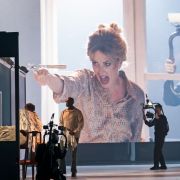
Where Trouble in Tahiti exposes the shortcomings of the American Dream from an insider’s view (it’s a proper ‘beware of what you wish for’), The Seven Deadly Sins charts the desperate inhumanity of the struggle to achieve it. The protagonist Anna (whose split personality is portrayed by the singer Anna I and the dancer Anna II) is touring the United States, egged on (or, in reality, pimped) by her family (the quartet serving as Greek Chorus) in the hope of hustling enough money to build their dream house by the river in Louisiana. Each city is the setting for a sin (Sloth, Pride, Wrath, and so on); each sin is brought about by the family’s uncompromising insistence on Anna raking in the money, whatever the physical and emotional cost to her.


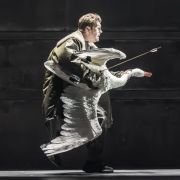
Stephanie Wake-Edwards was the pick of the evening’s singers, delivering Brecht’s sardonic lines with panache and the melodious nostalgic lines with beauty, commanding the stage and drawing every eye and ear. Yanki Yau danced Anna II with elegance, but did not capture the emotional tensions to the same extent: the piece could have taken a more extreme and demanding choreography than Monica Nicolaides provided.
The Greek Chorus – Holton and Haigh, joined here by Peter Lidbetter and Xavier Hetherington – performed well in their main purpose, which is to make us feel angry with them and what they are forcing on Anna.

Directed Valeria Perboni got good acting performances (including good diction in both languages) from her cast. However, it was stretching a point to describe this production as “fully staged”: Peiyao Wang’s costumes were effective at placing us in the periods of each opera, but the (mostly shared) sets were rudimentary, composed mostly of a series of open wooden frames which moved on casters. It would have been unreasonable to expect Covent Garden, but something more dramatic than this would have been possible.
But all in all, Opera Prelude provided a fascinating and satisfying evening of music drama and a fine showcase for their up-and-coming performers – and that, after all, is what they’re there for.