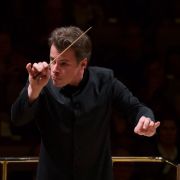
Sunday afternoon’s concert at Tanglewood was the last of this summer for Andris Nelsons, which probably accounted for the crowd packing the grounds and the nearby restaurants and accommodations. There has been grumbling from some more dyspeptic observers about “tension” blighting the summer idyll which is Tanglewood. None was palpable. Rather, there was a great sense of occasion and a feeling of support and gratitude. A prolonged ovation greeted the conductor at his first entrance, and a similar demonstration occurred when he and the orchestra filed onto the stage in unison after intermission.

Sarah Kirkland Snider conceived and composed Marmoris amidst the drama and discord leading up to the 2024 presidential election. In it she seeks to represent "the forces in life that hold and enclose us, those vast similitudes that connect us and remind us that we are part of something much greater than our daily human struggles might allow us to perceive". Though the Latin word marmoris (the genitive of the word for marble and meaning "marble-like") refers to the dappled sheen of a calm sea, Snider, unlike Debussy, goes below the surface to depict the variety of colors, currents, and life forms enclosed in the oneness of the ocean. Kirkland Snider further considers the orchestra itself an oceanic analog, "a seemingly living, breathing thing consisting of myriad unique life forms, pulsing swaying and churning in concert" to create "a shared human experience that transcends political, cultural, and ideological differences." Like Dante in the Divine Comedy, the orchestra is both creator and created in this piece.


Marmoris begins in the depths with a slow, low rumbling pulse from the double bass soon joined by the cellos. A shimmering evocation of the surface then parallels the waves from the depths with violins, violas, flute, and most importantly the harp joining in. Different combinations of instruments swayed and flowed into the mix dappling the oceanic vastness with a variety of colors, rhythms, and currents. The pace gradually quickened and the various parts of the orchestra coalesced for a rising, rhapsodic episode until all subsided in shimmering silence. The performance was so immersive that time ceased to register.

Joshua Bell has been a welcome visitor to Tanglewood for the past several years. Even though it’s high summer, he always comes bearing chestnuts. Many virtuosos tend to play piece's like Max Bruch's Scottish Fantasy on auto-pilot. In my experience, not Bell. These pieces have always sounded fresh and charged with the energy of someone sharing them for the first time. So I was a bit surprised by how detached he seemed from both the music and the orchestra. Who knows why, but a return to his recording of the work quickly reminded me of what he’s capable of when completely engaged.
Still there were parts that grabbed the ear. The somber solemnity which colors the mourning and lamentation of violin and orchestra at the beginning was so visceral that someone behind me whispered a little too loudly, "Did Scotland just die?" A hushed longing characterized the third movement, with Bell infusing the recurring trills with an unusual pleading quality. And few can refine their instrument’s sound down to a thin, silvery filament, even while trilling. His encore was a puckish, dazzling improvisation, arranged by himself, of Vieuxtemps' Souvenirs d’Amerique, a series of burlesque variations on "Yankee Doodle".


Schumann's Symphony no. 3 in E flat major is his Valentine to the Rhineland, encompassing its rustic simplicity and the glory of its cities. The exuberance of the first movement was initially weighed down by overly emphatic downbeats, but it eventually took flight, setting up a lively but more leisurely Scherzo. The third movement was even more becalmed, like a lazy summer reverie. The fourth expanded the perspective, reaching beyond the horizon to a timeless realm of light and shadow. The last movement playfully capered with a feline grace. Schumann’s recalling the previous movement amidst the jubilation knit all the symphony’s vignettes together, and Nelsons ended his penultimate Tanglewood season with a flourish. The audience in the shed rose to its feet. Prolonged rhythmic clapping, a first in my many years attending Tanglewood, kept recalling Nelsons to the stage