The Staatsoper Hamburg’s production of Frauenliebe und -sterben is an audaciously ambitious undertaking. Much like the Baroque tradition of the pasticcio, director Tobias Kratzer has engineered a sprawling family epic from three entirely independent works. One should not, however, go into the theatre expecting to find a forced, traditionally coherent narrative arc. Instead, the production is best understood as a series of striking cross-sections of women’s love and domestic life.

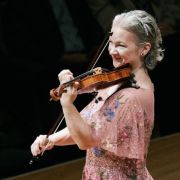
The evening opens with Schumann’s song cycle Frauenliebe und -leben. The scene is set within a grand salon, where women in expansive 19th-century gowns gather around a grand piano in a tableau of hushed, painterly stillness. Wisely, the dramaturgy eschews forced theatricality; instead, the stage is largely cloaked in shadows, with Kate Lindsey seated amidst luxurious furniture as if in a state of solitary monologue. Around her, other family members move in static, layered tableaux, creating a poignant sketch of a life lived and a life confined. Lindsey’s psychologically mature performance charted an arc from young girl's adoration to a man, to her own demise in childbirth as his wife, which deviates from the song's text. Her subtle interpretation exposed a tragic obedience to patriarchal, husbandly structures, transforming romantic fulfilment into a slow motion surrender of the self.


The transition to Bartók’s Duke Bluebeard’s Castle brings a stark, visceral contrast: the blood-soaked symbolism and suspense of a psychological thriller. The intensity of the emotional expression here is akin to witnessing an Edgar Allan Poe tale set to music. It is a descent from domestic apathy into a feverish psychological haunting, evoking a profound sense of hollow isolation within the vast, stately house.

Against this captivating landscape, Annika Schlicht’s Judith was a tour de force of relentless curiosity – an unyielding drive to uncover her husband’s hidden truths – while Johan Reuter’s Bluebeard exerted a chilling, calculated control, intentionally guiding his bride toward her inevitable end with absolute power. Their voices, characterised by a sharp, metallic brilliance, sliced through the dense orchestral fabric. To heighten the dread, the production utilised a variety of ghostly staging effects to manifest Bluebeard’s history of violence, rendering the gruesome remnants of his murdered former wives. This tension reaches a breathtaking peak as Bluebeard’s former wives emerge, including Kate Lindsey’s character, signalling that her ‘dead mother’ of the first act has been eternally absorbed into Bluebeard’s collection of captured memories. Mirroring this visual intensity, the Philharmonisches Staatsorchester Hamburg, under the uncompromising baton of Karina Canellakis, poured out the score’s latent violence and dark, cinematic imagery. The orchestra ensured that every groan of the castle and every drop of blood was felt viscerally, making the house’s psychological haunting a shared, shuddering experience for the audience.

The second half begins with a jarring, contemporary touch: a video fragment championing the “new man” of the 21st century, one who shares child-rearing and domestic duties. This serves as a sharp ironic foil to the world of Zemlinsky’s A Florentine Tragedy. Compared to the concise, gripping libretto of the Bartók, Zemlinsky’s lengthy dialogues, laden with period-specific background information about the protagonist’s business affairs, prove exhausting, making the eventual duel between the two men feel delayed.


The bedroom scenes are bathed in an unforgiving, nocturnal blue, where the bed sits like a desolate island of starched white linen amidst the encroaching shadows. The trio of soloists fought valiantly to sustain the drama. Johan Reuter, returning as the merchant Simone, was magnificent; he moved with a dangerous, oily servility that masked a lethal capability. His transformation from a cringing salesman to a cold-blooded killer provided the work's most potent thrill. As the prince Guido, Thomas Blondelle offered a bright, lyric voice that captured the character’s arrogant entitlement. Meanwhile, Ambur Braid navigated the role of Bianca with vocal poise, yet her character feels uncomfortably reduced to a mere accessory of the male ego – a striking regression from the vivid, psychologically complex heroines of the first half.

Yet what lingers longest after the curtain falls is not the blood-soaked spectacle of Bluebeard's castle, nor the duelling men of Florence, but the quiet devastation of Lindsey's final silence in the opening Schumann – a woman who gave everything and was left with nothing but the memory of having loved. Kratzer's creation offers no resolution. The stately house stands unchanged at the evening's end, its doors neither fully opened nor permanently shut, waiting for the next woman to cross its threshold and believe, once again, that this time will be different.