Britten’s War Requiem uses the familiar Requiem text, but inserts nine of Wilfred Owen’s anti-war poems at appropriate points to blend with it. This creates a dialogue between the ageless liturgy and the 1914-18 European war, in which the poet was killed in action aged 25, just a week before the Armistice. He had written a preface to a proposed collection of his anti-war poems, from which Britten chose lines to place at the head of his score: “My subject is War and the pity of War. The Poetry is in the pity... All a poet can do today is warn.”

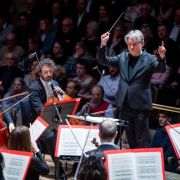
The War Requiem is a big work, 80 minutes of music for large forces. Here they spread right across both the platform, with the London Philharmonic Orchestra fielding over a hundred instrumentalists, and the choir stalls, where the Chorus of the London Philharmonic Orchestra was joined by the Chorus of the London Symphony Orchestra. It was quite a sight and they made quite a sound. Britten deploys his choir and soprano soloist to sing the Latin Mass, and requires a chamber orchestra of a dozen to accompany the Owen songs, given to tenor and baritone soloists. The chamber group was placed as usual just to the right of the conductor’s podium, occupied tonight by Principal Conductor Edward Gardner.


Tenor Paul Appleby was a replacement for the indisposed Allan Clayton, and if not quite Clayton’s match for lyrical sweetness, offered the requisite vocal heft and commitment. It’s a role he is familiar with, his biography listing an upcoming performance with the Vienna Radio Symphony Orchestra. He was especially touching in “Move him into the sun”, sung pp (whispered) as marked, the choral Lacrimosa interjections ideally matching the sense of a threnody. The aching line “Was it for this the clay grew tall?” sounded properly despairing.
Benjamin Appl too sang very well, with good English accent and diction. He rose splendidly to the challenge of “Be slowly lifted up, though long black arm” a brief, intense and powerful protest, punctuated by loud dissonant chords and bugle calls. He and Appleby were as one in the duet about Abraham and Isaac, with Owen’s reversal of the Biblical outcome, such that Abraham declines to reprieve his sacrificial victim but “slew his son, and half the seed of Europe, one by one”.

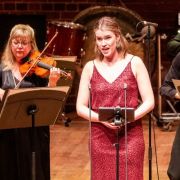
Natalya Romaniw had, as ever, plenty of accurate power, and was never shrill. She delivered thrilling impact when singing with the choir in big tuttis, but relished also her more intimate moments. She was not placed with the choir as the composer intended, but at the front of the platform, on the conductor’s left hand. The Tiffin Boys’ Choir and Girls’ Choir were excellent, clearly thoroughly prepared by Director James Day. For once they and the harmonium sounded ideally positioned in the Royal Festival Hall, slightly distant yet musically present. Gardner marshalled this army of singers and instrumentalists with consummate skill and feeling for pace, resulting in an exceptionally fine account of a work taxing to prepare – and even in some senses to hear. It is a lamentation on humanity’s bellicose folly, but ineffably consoling in its closing “Let us sleep now”.