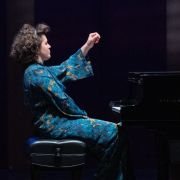
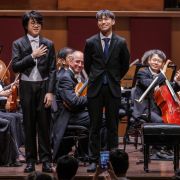
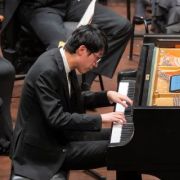
The tandem of Brahms and Dvořák make excellent bedfellows in concert, and it is a wonder why that does not take place as often as it should. One reason is that they are, perhaps, too similar in sound and substance, texture and tension. Nevertheless, this Singapore Symphony Orchestra concert was filled to the rafters, most possibly by pianophiles to catch Canadian pianist Marc-André Hamelin in Brahms’ Piano Concerto no. 2 in B flat major. Widely considered “the pianist’s pianist”, Hamelin is also the Pied Piper incarnate. Capable of casting spells on everybody who has seen or touched the instrument, this super-virtuoso makes the impossible possible and the extremely difficult seem like child’s play.


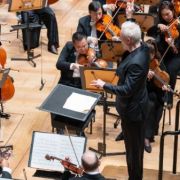
On Brahms’ own gift of understatement, his “few piano pieces” turned out to be this monumental symphony. His longest, if not for its massively demanding piano solo so well integrated into the sonic fabric as if it were an obbligato part. Was it happenstance that the opening French horn solo be assigned to fellow Montréalais Marc-Antoine Robillard, whose perfect intonation was matched by Hamelin’s immaculate entry and subsequent delivery? The orchestra led by German conductor Sebastian Weigle responded with vigour in the tuttis, as this was their show as much as Hamelin’s.

As a conventional piano concerto, this would still rank as one of the greats. And throw in a not-so-tiny Scherzo, its legend is made. Here, the concerto’s most treacherous passages, with playing very fast and very soft (sotto voce, pianissimo and legato all at once), all fell comfortably within Hamelin’s hands. Ng Pei-Sian’s solo cello in the Andante sang like a dream, reciprocated by the piano’s ruminative entry, later contrasted with the pitched battle with the orchestra. The finale’s Allegretto grazioso, ultimate lightness with the weight of the world lifted off Brahms’ shoulders, saw both piano and orchestra off to the races with the breeziest of finishes. This was a total hit, and Hamelin’s seemingly effortless technique was brought back with two “tiny, tiny wisps” of encores, Earl Wild’s Virtuoso Etudes after Gershwin’s Liza (No.1) and Fascinatin’ Rhythm (No.7). Would the gruff German in Brahms have minded? Given his penchant for wry humour, one suspects not.

Dvořák’s Seventh Symphony, the most Brahmsian of his nine symphonies and one with a Bohemian accent, completed the evening. Dvořák was eight years Brahms’ junior but was collegially encouraged by his senior. Little wonder how much the first two movements sounded so Teutonic. The drama of the opening Allegro maestoso was distinguished by the strings’ burnished richness, the warmth of woodwind sonorities stood out while overcoming exacting articulation in the Poco adagio, sleeper of a slow movement.

Only in the Scherzo did Dvořák consciously revert to his Slavonic roots, with the vigorous furiant dance infectiously captured by the orchestra. Going attacca into the finale, Weigle’s direction was not to put his charges in a rhythmic strait-jacket, but clearly allowing the music to breathe naturally. Through all the bluster, the enduring spirit of the dance was never forsaken as the symphony wound to an intoxicatingly exciting close.