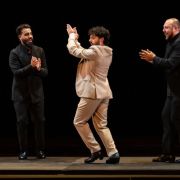
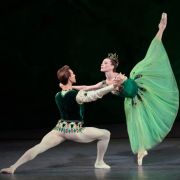
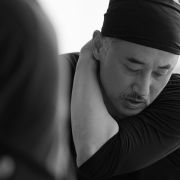
Johnny loves Johann. Caili loves Johnny. Jamar understands Johann. Johnny baffles Melissa. John could take or leave Johann. It was that kind of evening at New York's Joyce Theater – dotted with inspired moments, genial comedy, and superb musicianship from violinist Johnny Gandelsman in Johann Sebastian Bach. And also, some missed opportunities.

Gandelsman, one quarter of the boundary-busting string quartet Brooklyn Rider, spent years with the Silkroad Ensemble and champions both new music and music that speaks to our dark, complicated times. He has performed Bach’s cello suites for years, the violin’s lighter voice sharpening their dance impulse. It felt less a leap than an inevitability that he would invite choreographers into the mix.
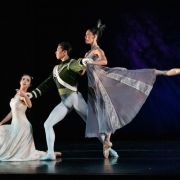
The democratic, collaborative process gave Melissa Toogood, Jamar Roberts, John Heginbotham and Caili Quan each a suite to choreograph and perform, with all four joining forces on the Third and Sixth. Along the way, distinct dance personalities crystallized and a few entrancing encounters took shape. Meanwhile, Gandelsman roamed the stage, displaying remarkable mettle given the stamina required to play all six suites in one go. He tore through them, finishing in just over two hours (with one intermission).


The preludes that open each suite belonged to him; they were among the evening’s most poignant stretches. The livelier movements drew on folk dance rhythms – mainly Irish jigs – which the choreographers met largely with variations on soft shoe. But well before the fourth or fifth movement of each suite, they seemed overwhelmed by the sheer volume of material, recycling ideas and passages that didn’t merit repetition: fidgeting as a stand-in for choreography. The evening cried out for a unifying thread and an editor.
The most successfully realized concept came in Suite No. 4, assigned to Heginbotham – formerly of Mark Morris’ troupe and now a freelance theatre and dance choreographer – and premised on the notion that he didn’t actually want to be there. Repeated attempts to exit via the wings were thwarted by his colleagues, who thumped his forehead or collectively marched him back to center. His movements registered ambivalence toward the music, with long passive-aggressive gazes at Gandelsman that cracked me up. At moments, though, a musical idea would grab him and send him soaring lyrically before he crashed back down to this humdrum existence. In his boredom he spied a jacket lined with a yellow feather boa and idly plucked at the “feathers”, which turned out to be crumpled paper. Soon his colleagues were pelting him with more paper from the wings – pages of handwritten scores, perhaps, discarded by frustrated composers. This provided light comic relief for the Sixth Suite in which the dancers arrived with brooms to sweep the mess away.

Melissa Toogood, a former Merce Cunningham dancer and now director of dance at the Juilliard School, was all elbows and knock-knees in Bermuda shorts – like an excitable kid trying to trap lightning bugs in a jar. She peered into Gandelsman’s eyes, regarded his bow with mistrust, slid under his legs, and steadied herself after a leap by leaning on his shoulders. As she lolled at his feet, I pictured two signs: “Stay Off the Grass” and “Don’t Touch the Musicians”.


Caili Quan, formerly of BalletX in Philadelphia, contracted and stretched in luscious phrases that mirrored the Fifth Suite’s more haunting moments. She seemed distracted, though, by a growing attraction to the violinist and managed to steal a slow dance before they parted. It could have been cheesy; instead, it was disarmingly sweet.

Jamar Roberts, former Ailey dancer turned choreographer, dove deeper into the music, tracing elegant paths across the floor in his stockinged feet, cleaving the air with powerful, sculpted arms. Hints of introspection and loneliness surfaced. Comic relief arrived in an outbreak of sketching: Quan posed winsomely in a chair while he fussed with charcoal and easel. After much faffing, he revealed his masterpiece: a portrait of Bach.
In the Sixth Suite, a vaudevillian turn in which the dancers slipped their hands into white sneakers and coaxed them into ballet positions did not do justice to the music’s lithe, mercurial filigree. By the final Gigue, the accumulated antics had worn thin and were not offset by much musicality beyond a few passages in Quan and Roberts’ choreography. The dancers occasionally clapped or stamped in time, while a long violin vibrato prompted gentle, full-body shudders. Still, a polyrhythm or two from the dancers would have helped.

At one point I thought this might be rich fare for Mark Morris – then remembered he already took on Suite No. 3 with Yo-Yo Ma in Falling Down Stairs. It opens with dancers falling down stairs, flat on their faces. Every movement idea sprung from the music. It was gripping from start to finish.