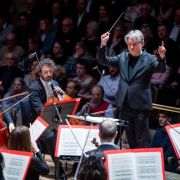
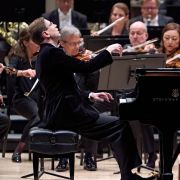
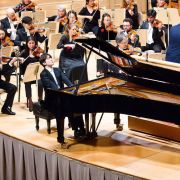
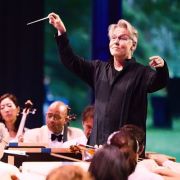
For the final concert of their Carnegie Hall residency, the Vienna Philharmonic and Andris Nelsons paired Richard Strauss’ Also sprach Zarathustra with Sibelius’ Second Symphony, composed barely five years apart at the turn of the 20th century. Though heirs to Wagner, Bruckner and Beethoven, the two composers point toward different futures: Strauss expanding the orchestra toward expressive saturation, Sibelius reshaping symphonic logic from within.

Too often, the impression of Also sprach Zarathustra is held hostage by its famous opening. Nelsons resisted treating the Sunrise as a self-contained climax, leaning into the Vienna Philharmonic’s opulence without letting the sound sprawl. The initial pedal C, fusing double basses, contrabassoon and organ into subterranean resonance, established a firm grounding; the trumpets’ unison fanfare rose with rounded authority, integrated into the orchestral fabric rather than set apart.


The span that followed was shaped with architectural awareness. In Of the Backworldsmen, the strings sustained a dark sonority, phrasing broad yet defined. Of the Great Longing unfolded in a cumulative swell, winds and brass integrated into the expanding texture. In Of Science and Learning, the divided strings articulated the fugal writing clearly, contrapuntal lines audible as the texture thickened. The build-up in The Convalescent was paced patiently, the return of the opening motif arising from accumulated weight.
In the Tanzlied, Nelsons let the tempo ease slightly, concertmaster Volkhard Steude’s violin rising naturally from the texture, supported by the lilting waltz rhythm. At the close, the texture thinned and the music remained suspended. What emerged was not simply an early tone poem in Romantic dress, but a score pointing toward Strauss’ later soundscapes – from the Viennese lyricism of Der Rosenkavalier to the inward gravity of Metamorphosen – and Nelsons allowed those premonitions to register.
Nelsons approached Sibelius’ Second Symphony less as proclamation than as process, an evolving continuum. If the Strauss tone poem opened with a declarative gesture, Sibelius sets his symphony in motion with a compact motif that accrues meaning through repetition. Nelsons stated the opening figure without rhetorical weight, its expansion carried by woodwind colour rather than dynamic insistence. Resisting any impulse to underline the dance rhythms, he let the music’s motion grow from its internal pulse.


The Andante formed the work’s gravitational centre. The low strings’ pizzicato set the ground over which the sombre bassoon theme unfolded. Nelsons avoided overloading the texture: muted brass entered with contained weight, climactic surges were terraced rather than unleashed, and cesurae seamlessly integrated. The tension lay not in overt drama but in the deepening of sonority, the harmonic shadows darkening without distorting momentum.
Nelsons kept the tempo taut in the Scherzo, rhythmic bite clear yet controlled. The strings’ rapid figures carried nervous energy without fraying. In the Trio, the repeated-note figure, first voiced by Sebastian Breit on oboe, provided a brief inward focus before the restless motion resumed. The attacca into the Finale felt continuous, accumulated tension carrying forward without release. The broad D major theme emerged from the orchestral fabric, supported by rounded brass and cohesive string weight. Nelsons shaped the long crescendo patiently, letting the structure gather breadth without forcing its arrival. The closing pages expanded fully, the final bars granite-like and luminous.
Nelsons can sometimes overindulge detail, but in this Vienna Philharmonic concert he proved a commanding symphonic architect.