It was a curious evening, inspired at times, indifferent at others, ill-judged in places. Good, bad, but never ugly. Through it all, the London Symphony Orchestra did its level (and considerable) best to smooth over the evening’s potholes. They played like heroes in two of Debussy’s three Nocturnes: sublime in Nuages where their pianissimi and expressive elisions sounded less like mere clouds than the waft of seraph wings. Patrick Flanagan’s cor anglais solo provided a special moment of ecstasy here. Fêtes, too, was exquisitely played and the beauty of the LSO’s muted trumpets elicited shivers.

Then they stopped. No Sirènes! For want of a choir the structure was lost and Debussy’s triptych simply broke off, unresolved. Yes, this attenuation reflected the first performance at the unfinished work’s 1900 premiere, and it had been trailed as such in the publicity for this concert, but we have become so accustomed to hearing the completed sequence that this felt like an affront to Debussy. Bleeding chunks on easy-listening radio are one thing, a serious concert by a great orchestra is another. Could they not have phoned round a few London Symphony Chorus ladies to help them finish the job?


If concert duration was the concern, we could happily have forgone Patricia Kopatchinskaja’s fillers before and after her performance of the Berg Violin Concerto. That masterpiece can speak for itself rather than being topped by an Austrian folk tune and tailed by Bach’s Es ist genug, for no better reason than because Berg alludes to them both. While the orchestral strings swished up and down on harmonics, the Moldovian-born soloist made a showbiz entrance – quite out of keeping with the concerto that followed – playing a Brahmsian lullaby from Carinthia while she walked and glaring at the hapless spectator who applauded her en route.
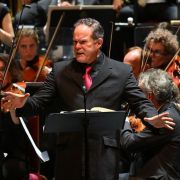
The mood duly broken before the concerto had even begun, Kopatchinskaja set to work. Gianandrea Noseda accompanied with delicacy and sensitivity as Berg’s final masterpiece unfolded with beauty from both soloist and conductor. Breath was held during the rising and falling arpeggio figure that Benjamin Britten quoted in his Hymn to St Cecilia and it remained held until the cathartic reference to the aforementioned Bach chorale in the closing minutes. On occasion the soloist disappeared beneath waves of tutti overlay (too much, Mr Noseda, too much!) while her reluctance to get her hands dirty and ‘play ugly’ sanitised the impact of a many-hued concerto that suggests rather than flaunts its emotional inspiration. As for the Es ist genug bonus, despite some precise vocal work by members of the orchestra it was a superfluous accretion.


Noseda then led the LSO through an immaculately professional account of Rachmaninov’s First Symphony. He resisted the temptation to lean heavily into the work’s romanticism but instead used it to celebrate the virtuosity of his orchestral colleagues. The first movement opened with orchestral bloom rather than bombast; it progressed through sweeping beauty from the violins and moments of startling attack to cutting brass playing and to thrilling ensemble work from the cellos and double basses in Rachmaninov's writing for low strings.
The ensuing Allegro animato sallied forth with well judged élan, but the Larghetto third movement was left to its own devices. Noseda’s phrasing was penny-plain here and he made no apparent attempt to shape any kind of musical argument. Yet the symphony’s Allegro con fuoco finale was aflame. You can always rely on the LSO to give good fuoco and the percussion sang forth with military precision while the climactic tutti resembled a collective seizure. In a good way.