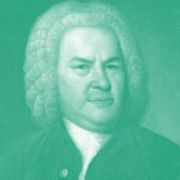
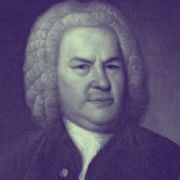
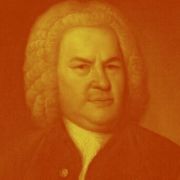
It’s no surprise that the composer most represented on NASA’s Voyager Golden Record – a compilation of humankind’s greatest hits stashed on the spacecraft launched into interstellar space in 1977 – is Johann Sebastian Bach. Alongside a Navajo night chant, Javanese gamelan and Louis Armstrong channeling the blues, Bach’s miraculous creations await encounter with extraterrestrials who, after spinning the album on their local radio stations, may feel compelled to chart a course for New York’s Lincoln Center, where New York City Ballet has programmed a rare all-Bach evening.

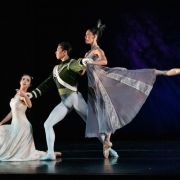
They would first encounter Emilie Gerrity and Unity Phelan in Concerto Barocco, George Balanchine’s timeless embodiment of Bach’s Double Violin Concerto in D minor. Weaving tightly in and out of each other’s orbit to the score’s fierce counterpoint, the two ballerinas exchanged glances as if sharing an intoxicating secret – Gerrity more volatile and quirky, Phelan refined and serene. Gerrity charging out of the gate in the third movement was epic, as were Phelan’s lush, sweeping extensions. They’ve steered many Barocco missions together, though notably Phelan has returned this season at full power, just 11 weeks after giving birth.


Further excitement came in a debut from Owen Flacke, whose job was to pilot Phelan safely through the air, through a thicket of bourrée-ing corps dancers, and across an invisible raging river. It’s one of those roles where, if anything goes wrong, it’s on him, and if everything goes right, the audience remembers only the ballerina’s ascendance. But Flacke flaunted his own beautiful, yearning lines and harnessed formidable power in his rangy frame, most notably in a herculean sequence of lifts where Phelan drove forcefully off one foot, her legs inscribing a rainbow before each touchdown and renewed launch.

The corps women were at once landscape and valiant entourage: sleek, energized and unflappable. Undaunted by lead violins who occasionally veered off course, they marked time scrupulously with airy traveling hops on pointe, the precise lowering of their arms a semaphore exquisitely timed to each interval change and tectonic shift in the score’s internal architecture. Their bourrées quivered hauntingly, evoking the moonlit forest glade in Giselle, but their crisp step-ups into arabesque piqué traveling forward and back, at speed, situated them on an interstate parkway.
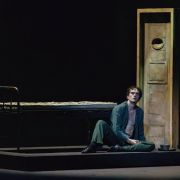
Jerome Robbins’ titanic Goldberg Variations unspooled luxuriously, taking every repeat in the score and layering reveries that flirted with chaos until a rousing denouement in which Tiler Peck, Joseph Gordon and pals finally busted out the bravura ballet moves that the ballet withheld for the first 80 minutes. Pianist William Wolfram played more loosely than I recall from last season, yet the ensemble was on fire in even the most understated episodes.

Ava Sautter and Shane Williams, gorgeous and authoritative in the opening and closing aria, delivered every baroque flourish and interpolated hip check with grave conviction. Their courtly finery gave way to practice clothes for the ensemble, before hints of ruffles and soft tutus returned: bending time, garment by garment. Ashley Hod sailed jauntily through the air. Emma Von Enck, lively and unmannered, joined her in a duet after observing David Gabriel and Andres Zuñiga’s sportive, lighthearted interplay.


Classroom exercises – led by Sebastián Villarini-Vélez, whose ebullience compensated for a lack of pliability – morphed into playful, winsome exchanges. But when the time came to put childish things away, the women hurled themselves into the air, to be carried off in a succession of gorgeous overhead lifts as a contingent in blue swept in like a tidal wave. The leggy, vivacious Ashley Laracey feigned sudden fits of exhaustion to get Peter Walker’s attention, draping herself over his arms – as if clinging to a lifesaver in rough seas – before finally diving through them.

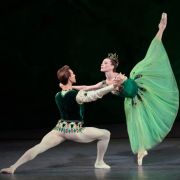
Isabella LaFreniere proved even more high-maintenance in the arms of Ryan Tomash, prompting treacherous promenades and dramatic off-kilter développés. Tomash, in a vivid debut, perked up when she finally walked out on him. The invincible pair of Tiler Peck and Joseph Gordon tangled in an affectionately competitive dynamic: she whipped up a tornado of piqué turns and stopped on a dime; he spun grands pirouettes out of his back pocket. She flung herself at him; he ran backward with her high overhead. Much as this may sound like a classical wedding pas de deux, it was really two American kids leaving it all out there. Tempered by Bach’s cerebral experiments, however, the ballet’s unfolding vicissitudes of friendship carried a lingering bittersweetness, as of time running out.
Harpsichordist Jean Rondeau spoke of the Goldberg Variations, of the “vibrations that the sound causes to arise in our body – it’s hard to put into words precisely… that the music has the power to awaken, when everything else is extinguished.” At a moment when much of the world feels like it’s going dark, Robbins’ dance trusts that Bach’s vibrations still move us.