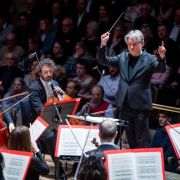
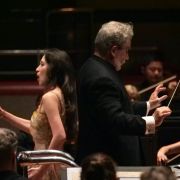
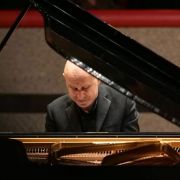
Mozart’s Piano Concerto no. 23 in A major was the perfect sandwich filling of grace between the impassioned energy of Hector Berlioz’s Roman Carnival and the swirling seas of Rimsky-Korsakov’s Scheherazade. Scottish pianist Steven Osborne interpreted it with great maturity. This was not a showboating display of virtuosity or a case of pushing the score to extremes, he clearly left all that to the City of Birmingham Symphony Orchestra under Kazuki Yamada in the more dynamic orchestral pieces.

Instead, Osborne approached Mozart’s concerto with a paradoxical air of precision and informality. One could close one’s eyes and imagine him playing at home next to a cosy open fire in his dressing gown and slippers, the orchestral parts playing in his head. He brought to the piece a sense of delight in its form and order, and his touch was elegant and graceful, bringing out exceptional clarity in the articulation. This was especially true of the Adagio where his bell-like tone emphasised the serene cantabile melody, through which one’s awareness of time passing was suspended.


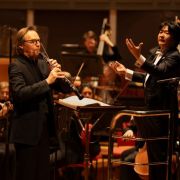
For me, however, the move to the Allegro assai did not quite shift into top gear. This was where Mozart was having his fun with the composition, and this came over from the orchestral accompaniment as Yamada’s joyful frame bobbed about behind the piano, yet the piano, though interplaying with the pairings, echoes, calls and responses, remained a tad understated. Nonetheless, Osborne's relaxed style charmed the audience at Symphony Hall again in his wonderful encore, a jazz-infused composition which sparkled with subtle colours in a perfectly measured performance at once redolent of classical heritage and yet quite modern.

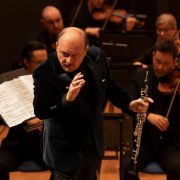
Charitably, the CBSO, Osborne and Yamada offered their services completely free as this concert was a fundraiser for the CBSO Benevolent Fund, which takes care of the welfare of active and former members of the orchestra in times of crisis. The obvious option for a fundraising programme was a big hitting repertoire favourite, and few large-scale orchestral pieces are as popular with audiences as Rimsky Korsakov’s Scheherazade. It is an ideal work to introduce to young people who may be interested in taking up an instrument, especially if they can see an orchestra perform it live, as it exposes so many instruments to wonderfully lyrical solo passages. In performing these, it was clear that the CBSO members were clearly relishing the opportunity, and although every solo was delivered with panache, the clarinet, oboe, bassoon and flute were notably exceptional. The lead violin, which anchors the narrative of the work, was also brilliantly performed and supported by a robust foil of crystal-clear harp arpeggios.


Scheherazade is noted for its orchestration, so during tuttis, Yamada had his own chance to shine. He kept the CBSO well balanced and presented the familiar with freshness, bringing out aspects of the orchestration I had not noticed before— a bassoon run here, a horn fanfare there— and all at a perfectly chosen tempo, delivered with gusto.