After 25 years with New York City Ballet, Megan Fairchild will give her final performance on the 24th. Yet, Friday night’s Coppélia at Lincoln Center was hardly bittersweet; instead, it was the most joyous, exalted rendition I have ever witnessed. Choosing this particular ballet for her farewell was deeply appropriate. At just 19, during an NYCB summer season in Saratoga, she was thrust into the role of Swanilda as an understudy after all the leads were injured. A rare comedy by Balanchine after Petipa and Cecchetti, Coppélia features a heroine who is just as funny, feisty and full of life as the Fairchild audiences have come to know through her dancing, her interviews and ebullient social media presence.

Set to Léo Delibes’ illustrious score, Act 1 unfolds in an Austro-Hungarian village tucked away in the Carpathian Mountains, pairing perfectly executed mime and sparkling humor with exuberant dance. As the toy-maker and mad magician, Dr. Coppélius, Robert La Fosse portrays a lovable yet creepy eccentric. He is delightfully unkempt, easily distracted and arguably redolent of mothballs and turpentine. He has propped his newest creation on his studio balcony for all the village to see: a beautiful, lifelike doll unable to speak — his version of the ideal woman. When Fairchild’s Swanilda enters, she attempts to befriend the new stranger. She waved warmly, offering a spirited dance of sharp petit allegro, effortless grands jetés and unflappable balances in arabesques to impress her — but to no avail. Annoyed by the cold reception, Swanilda stomps her feet in frustration and huffs off.


As Frantz, Joseph Gordon portrays an adorable dolt. While he loves Swanilda, he is easily distracted and becomes captivated by the beautiful doll on the balcony; mistaking her for a real woman, he flirts and swoons beneath her perch, to the growing annoyance of our heroine. Fairchild proves herself an exceptional character actress, commanding the stage from the moment she enters. She is the quintessential soubrette — petite in stature but immense in stage presence.
The townsfolk fill the stage in a lush palette of corals and teals, beautifully mirroring the hues of the rustic sky and the floral stage scrim. They bring the scene to life with infectious mazurkas and csárdás, navigating intricate musical counts and complex, alternating beat emphases with effortless grace.

In Act 2, Fairchild’s Swanilda brilliantly mimics the doll coming to life, executing a fiery Spanish fandango and a Scottish reel that showcase her technical and stylistic mastery. Her ingenuity ultimately thwarts Dr. Coppélius’ devious plot to drain Frantz’s life force for his creation, culminating in a successful rescue and their escape.
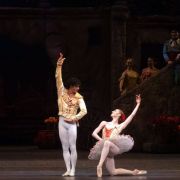
Act 3, titled The Festival of the Bells, centers upon a celebratory suite of divertissements culminating in the wedding of Swanilda and Frantz. The act is sometimes considered gratuitous, as it features original Balanchine choreography introduced in 1974, contrasting with the first two acts, which are updates of the Petipa and Cecchetti stagings of the late 1800s. Among the highlights were the young students from the School of American Ballet; dressed in shimmering golden pinks, they danced alongside soloists and were an absolute joy to watch. In their pas de quatre, the Four Jesterettes — Sierra Griffith, Claire Kim, Maya Milić and Kylie Takeno Williams — delivered lively allegros and subtle acoustics, their costumes adorned with bells. Ultimately, however, it was Fairchild and Gordon who carried the act, anchoring the celebration with a series of breathtaking lifts, solos and exquisite pas de deux.


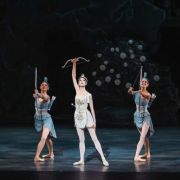
My single grievance lies with the ‘Discord and War’ divertissement. While the piece is intentionally designed to disrupt the harmonious flow of the performance, the heavy costumes, unflattering gowns and weighty trains of the headpieces worn by the corps de ballet seemed to visibly strain their movements and necks. And the concept of war was dully depicted, with the heavily garbed royals carrying flimsy spears as symbols of defence.
Ultimately, the evening belonged entirely to Fairchild. She performed with flawless technical precision and radiant joy, charmingly blowing kisses to the audience throughout the night. Her Swanilda was gutsy, determined, inquisitive, highly observant, slightly mischievous, opinionated and a problem-solver. Au revoir, Ms. Fairchild — you will be deeply missed.