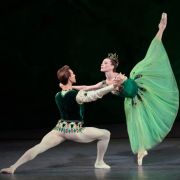
Young children are a tough crowd, it turns out. In the theatre, they do not hold back judgment. On Saturday afternoon they were understandably perturbed when two of their peers, Margo Bernstein and Oscar Russell, strayed into a forest and were forced to hide from a scary lion (a splendid Isaac A. Garcia). An escape route presented itself when the lion fell asleep: in the children’s dash for freedom, one nimbly leapt over his sleeping form, but the other “accidentally” landed on his tail. Pandemonium ensued. The young crowd in the house voiced their approval as the intrepid Bernstein landed a neat jab on the lion’s snout. But the rest of the woodland animals closed in on the children, brandishing colossal forks and knives. Bernstein and Russell soon found themselves in a large cauldron, bound with vines. You could cut the tension in the auditorium with a diamond sword.

This is New York Theatre Ballet’s Carnival of the Animals, a streamlined, hour-long spectacle from the estimable chamber company’s Once Upon a Ballet series. Its productions favor portable, jewel-box settings and Sylvia Taalsohn Nolan’s exquisitely detailed costumes whose splendor rivals that of grand opera, while the choreography preserves classical finesse and treats its young audience as discerning viewers.


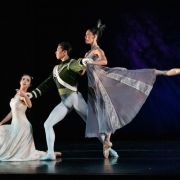
Carnival was choreographed by Beth Storey Taylor for a parade of creatures, each quirkier than the last. A hen and rooster (Kristina Shaw and Mitchell Welsh), their light, fluffy layers suggesting plumage without a feather in sight, squabbled and picked at the ground with staccato precision. Two sleek horses (Julia Felippi and Samantha Sacks) leapt and galloped as if the modest stage were a vast plain. Omar Rodriguez’s donkey and Gion Treichler’s elephant moved with surprising grace – the latter, in a tailcoat and wielding a violin, slid deftly into the splits. A bounding kangaroo (Demi Trezona) paused to let her joey (Adair Brannen) catch up – and to reapply her lipstick. Goldfish Giana Parlin and Alexander Marmolejos, in gleaming hand-painted unitards trimmed with fin-like ribbons, fluttered and unfolded into striking overhead lifts that drew audible awe from the young audience. Not to be outdone, Sarah Fernanda Stafford’s scarlet bird flashed fleet, ebullient pointe work and speedy turns down the diagonal that finished in a steeply arched balance.

Spoiler alert: Diana, Queen of the Forest (Sarah Simon Wolff), swoops in at the eleventh hour. Though armed with bow and arrow, she subdues the insurgent creatures with her regal port de bras. The lion, chastened, dabs at tears of shame with his tail before launching into a whirlwind of pirouettes, and leads the repentant ensemble into a jubilant finale.
With unerring taste, the program paired Carnival with Antony Tudor’s Little Improvisations – one of many chamber works by Tudor and others that company founder Diana Byer spent decades championing. While Tudor’s gripping psychological dramas are better known, Little Improvisations hints at swirling currents beneath its deceptively light surface.

Woken from a nap by Schumann’s Kinderszenen, Op. 15, Parlin and Garcia breezed through a series of childish games in which they deployed a simple tablecloth as a flag, an animal costume, a baby’s swaddling blanket, and a royal cape. The pair indulged in bits of folk dance and airy lifts with appealing nonchalance. Her crystalline petit allegro and his explosive jumps and tours en l’air betrayed a competitive spirit.


Their games were pierced by isolated flashes of sensuality and sadness: a yearning arch of the back in développé; her cheek resting against his thigh as they settled back down to sleep. When the baby blanket unwound into nothingness, the illusion of childhood dissolved. In its place a sharp, sudden grief – perhaps for a lost child – revealed two adults not at play but revisiting the ghosts of a shared past.

These readings may have eluded the younger cohort but Tudor’s ability to keep them entranced was evident when a boy to my right pronounced the ballet “just a crazy dream.”
Although many of Theatre Ballet’s productions employ live music – often just a piano – this run relied on recordings of Saint-Saëns and Schumann, the former piped in at too low a volume, dulling some of the score’s magic.
Even so, the program feels like a small miracle. Resources are uncommonly tight for American companies of every size, as benefactors are stretched thin sustaining the social programs and cultural institutions that the federal government has laid waste to. New York Theatre Ballet – which is known for accomplishing much with very little – faces added strain amid a leadership transition, with Antonia Franceschi newly arrived to succeed Steven Melendez, who curated this program. The afternoon had the air of an all-hands-on-deck effort: Diana Byer returned to oversee the staging while Franceschi led the children in the audience through ballet games as stagehands quietly struck the set between pieces.