West Australian Opera’s new Eugene Onegin comes in a recent production from Northern Ireland, directed by Cameron Menzies. It is a most successful rendition, with one irritant; with respect to the performance, there is nothing to complain of. Confidently performed in Russian with English surtitles, it is a treat for eye and ear, with only the small part of Monsieur Triquet and his French verses being omitted (no great loss, in my view).

The set embraces the whole stage, sparsely decorated with chairs and an upended sofa, representing both interiors and exteriors. At the beginning, a large (modern looking) hay bale is present at the back of the stage, making clear the rustic mise-en-scène. Before the orchestra strikes up, an elderly woman in a wheelchair can be discerned behind a scrim.
Menzies, in the program notes, sees the opera as being about the journey of Tatyana – although it is arguably equally about that of the eponymous Onegin – and thus frames the opera “through the perspective on an older Tatyana, now in a nursing home on her birthday”, sigh, with a balloon no less, “so we can explore the opera … as an act of remembrance”. Yes, we’ve been here before, only with dancers as avatars of the principals (Sydney earlier this year), and as I remarked then, the opera is already about that, so we don’t need to be told. So not only this figure in modern dress, but also her nurses and carers in their scrubs, wander inconsequentially about the set at different points of the narrative.


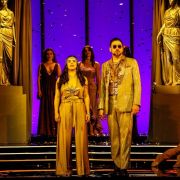
This is a pity, as it distracts from an otherwise beautifully realised interpretation. The always excellent West Australian Opera Chorus was augmented in the crowd scenes by a troupe of five dancers, and their movements were choreographed into a seamless whole by the movement director, Jennifer Rooney. The elegant costumes (by Gillian Lennox) were closer to Edwardian than the early 19th century setting of the original, which at least is more or less congruent with a later-20th-century Tatyana. My only reservation was Tatyana’s hat when she appears as Princess Gremina, looking like Marlene Dietrich as Catherine the Great out riding, not something one would wear to a ball. Otherwise the ballroom scenes were the exact sort of spectacle they should be.
Also impressive was the Peasants’ chorus, with the singers in pagan masks and waving pitchforks, performing ritualistically and calling to mind The Rite of Spring. I’m not quite sure why the duel took place on a table, apart from making a nice tableau when the shot Lensky fell off it into the arms of the seconds.

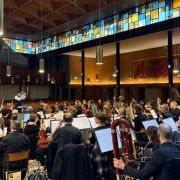
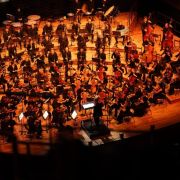
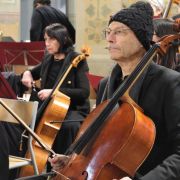
The West Australian Symphony Orchestra was in very fine form, featuring some of their principal players: notably concertmaster Laurence Jackson; Mary-Anne Blades on flute; Liz Chee on oboe; and Jenna Smith on trumpet. Under Christopher van Tuinen they made the most of the sumptuous score while providing excellent support for the singers.
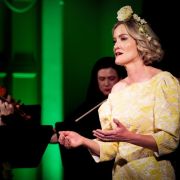
Soprano Eleanor Lyons as Tatyana was outstanding in the role, singing with gleaming power and radiant grace. She hit all the high notes full-on with no sense of strain. Her acting was always fully in the moment; from shy young girl, to swept away in romantic passion, to dignified aristocratic wife, she was entirely believable. Similarly Ashlyn Tymms, well known to Perth audiences, brought her creamy mezzo-soprano to the role of Olga, portraying the more carefree younger sister, outraged by Lensky’s jealousy and shattered by his death. Their mother, Madame Larina, was well sung and sympathetically played by Brigitte Heuser, and a third mezzo-soprano, Nicole Youl, was an entertaining Filippyevna.


The name part was taken by Samuel Dundas, recently seen as a baritone Nerone in L’incoronazione di Poppea, singing with strong resonant tone. He acted rather stiffly, although of course it is not a very sympathetic part. Local tenor Paul O’Neill never disappoints, and he sang Lensky’s part beautifully, with plangent tenor voice, and acted out the range from young man in love to distressed suitor betrayed by the man he thought was his friend. Teddy Tahu Rhodes brought his rumbling bass and suitably authoritative demeanour to the role of Prince Gremin – although the rumble has a bit more wobble these days.