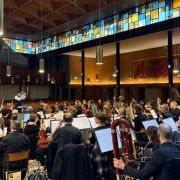
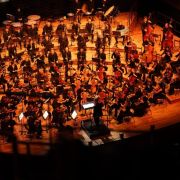
With Joanna MacGregor at the helm, Brighton Philharmonic Orchestra continues to impress, their 101st season so far including Nyman, Vasks and Coleridge-Taylor side by side with more familiar fair from Mahler, Britten and Mozart. They’ve also found a way to make budgetary constraints work to their advantage. So there have been concerts with reduced chamber orchestra forces, but exploring more interesting repertoire than the traditional overture-concerto-symphony sandwich. This has definitely borne fruit in attendance, with audience sizes gradually rising from a slightly moribund third to half a few years ago, to almost filling the Brighton Dome.

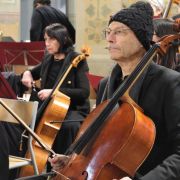
Vaughan Williams’ Fantasia on a Theme by Thomas Tallis was a great place to start, allowing the BPO strings to demonstrate warm tone and strong ensemble. After a slightly hesitant first entry, they settled into a confident rendition, and MacGregor balanced the switches between the main orchestra and the reduced second group of just nine players positioned behind. The solo quartet of principals was also very assured with particular mention deserved for lead viola, Caroline Harrison’s rich tone, her flowing countermelody shining through against Ruth Rogers on first violin. A little more bite at the climaxes would have been welcome, but otherwise this was a smooth performance with a uniformly mellow string sound.


In his highly successful if over-wordily titled Recomposed by Max Richter: Vivaldi – The Four Seasons, Richter contrasts movements in which most of Vivaldi’s music remains relatively intact with others where he uses one small idea as the kernel of something very new. MacGregor and the BPO strings chose to mix and match a few movements from Vivaldi’s original composition for Spring and Winter with some from Richter’s recomposition, with Ruth Rogers on solo violin. For the Richter, there is an additional harp, but also a harpsichord, and here the decision for MacGregor to use an electric keyboard for the harpsichord was an unfortunate mistake. The harpsichord ‘setting’ had a noticeably electric tone, too loud, and jangling inappropriately particularly at cadences. This was a pity, as otherwise, this was a highly enjoyable rendition, with Rogers leading with spirit, dancing to the offbeat rhythms in Richter’s obsessive take on Spring. The pecking violins were on the dry side here – a little more actual note was needed – but the slow crescendo was effective. The Vivaldi had swing and energy, whilst Richter’s Winter’s 7-beat twist had MacGregor standing up and jamming at the keyboard. Vivaldi had the last word, and the BPO strings positively fizzed, almost managing to mask the clanging keyboard.
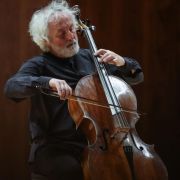
But the star of the show proved to be cellist Guy Johnston, with an intensely focussed performance of John Tavener’s hypnotic The Protecting Veil. A meditation on Mary, the Mother of God, its eight sections are musical “icons” of her life. There are consistent elements running through – a rising three notes that begin the chant-like melodic line, a sweeping slide, and glassy chimes from the full strings – and Tavener uses plentiful technical devices such as inversion and repetition, but ultimately, the meditative nature disguises any obvious calculation. It requires the soloist to be totally committed to its world, and Johnston certainly was, particularly in the lengthy unaccompanied fifth section, where he gave some of his quietest, most intense playing. MacGregor led the BPO with precision and their pealing interjections had a real shine. Meanwhile, Johnston’s variety of tone, from plaintive higher registers, through a warm mid-range, to mournfully rich lower notes, was astonishing. A wonderful performance from Johnston, but also raising MacGregor and the BPO strings’ game to a new level.