Glyndebourne’s Billly Budd is back, and certainly shows no signs of age. Premiered in 2010, it returned in 2013, with a brief stint in New York the following year. Michael Grandage’s production, now revived by Ian Rutherford, brings the confined all-male world of a ship to life in a visceral way. Christopher Oram’s set surrounds the stage, enclosing the cast and drawing us into the claustrophobic belly of the ship, made even more with minimal scene changes involving closing the space down even further from above.

The only moment of release comes towards the very end with a small expansion of the set allowing an intake of breath after the cumulative tension of the previous two hours. A lot of effort to go to for a relatively minor visual trick, but worth it. Paule Constables’ lighting brings occasional shafts of light to this otherwise dark and murky underworld, with slow fades effectively accompanying Britten’s lengthy orchestral episodes.
The story of innocent Billy Budd, captured from a merchant ship, the Rights o’ Man, and pressed into service on HMS Indomitable is one of tragedy, violence, obsessive lust and ultimately, human weakness and failure to ‘do the right thing’, in the face of seemingly intractable legal requirements. The evil Master-at-Arms, Claggart, takes against Budd (whom he secretly desires – more of that later) and frames him, but when confronted with this, Budd is unable to defend himself (due to his stammer), lashes out and kills Claggart, thereby sealing his fate, as the ship’s captain, Vere, refuses to intervene and save him. This all plays out with operatic inevitability, leading to Budd’s tragic end. As if to accentuate the overall doomed sense of failure, there’s an abortive battle scene, with all the dramatic build up (beautifully choreographed) but no consummation, as the French enemy escapes into the mist, and the Indomitable is left impotent in their windless wake.


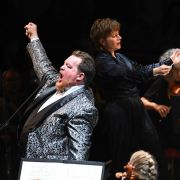
Thomas Mole’s Billy, full of wide-eyed innocence, held onto his blind belief in Captain Vere right to the very end, despite evidence to the contrary, and was convincingly moving throughout. His Act 2 Christ-like scene as he awaited his execution had devastating simplicity, and the turnaround of his relationship with former father-figure Dansker (in a warm performance from Clive Bayley), now calming and reassuring the older man, was highly touching. Allan Clayton’s steely tenor was impressive as ever as Vere, and the transition from the troubled and flawed captain to the haunted old man of the Prologue and Epilogue, reflecting on his failure to protect and save Billy, was powerfully moving.

Sam Carl (Claggart) had the vocal range and although his lower register occasionally lacked a little power, his baritone was penetratingly evil. Overall, this revival seems to dampen down the homoerotic implications of the central triangle. It is clear from the text that the reason Claggart decides to destroy Budd is because he wants him and knows he can’t have him, and when Vere says he knows all about Claggart, this surely means he understands this (and feels some of the same desire). Carl’s Claggart didn’t really communicate this sublimated desire, focussing more on the violence, and consequently, Clayton’s Vere also couldn’t illuminate the latent homoeroticism in the relationships in response to this. We were largely left with Claggart as downright evil and Vere as failing to stop him – all true, but the subtext was certainly clearer in my recollection of the 2010 production.

Dingle Yandell (Redburn), Daniel Okultich (Lieutenant Ratcliffe) and William Thomas (Flint) gave strong turns as the somewhat bemused officers, drawn into having to condemn Budd in the absence of any clear leadership from Vere. Two veterans of earlier runs returned – Michael Wallace as First Mate, and Alasdair Elliott as Red Whiskers, one of the other pressganged men, quickly turning from indignant protest to acceptance of his new world. The chorus excelled at full-voice, as well as in their quiet chanting resignation, and their choreographed resistance and rapid movement around the levels of the set were solid and convincing.


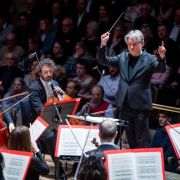
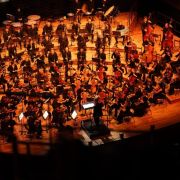
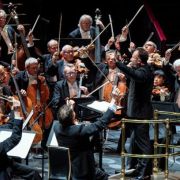
Nicholas Carter conducted the London Philharmonic Orchestra with precision and energy, bringing brilliance to Britten’s searing score, especially from the gleaming brass. The seemingly endless sequence of chords accompanying a dark stage, when Vere is breaking the news of his fate to Budd offstage, were truly heartbreaking in their weighty simplicity, as was the plaintive piping piccolo commentary on Billy’s final aria.

A welcome return, then, for this now classic production, but with potential for EM Forster and Crozier’s libretto, and its underlying expression of “the love that dare not speak its name” that was surely central to Britten’s intentions, to be more integral in the characterisation of the central roles.