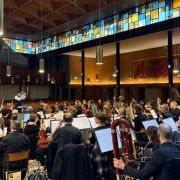
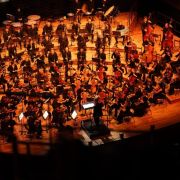
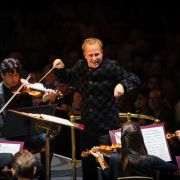
There’s an obvious advantage of seeing a major choral work conducted by its composer: you can be 100% certain that the piece is being conducted in line with the composer’s intentions. That advantage is multiplied when the conductor is as focused and detail-conscious as Sir James MacMillan and when the work is as varied, richly textured and carefully structured as his Christmas Oratorio, performed by the BBC Symphony Orchestra at the Barbican last night.

This Christmas Oratorio doesn’t feel like a traditional liturgical piece, wrapping the storytelling of its two central ‘tableaus’ with orchestral scene-setting and metaphysical poetry as well as more standard liturgy, entrusted to the chorus. From the start of the introductory Sinfonia 1, there’s plenty of the magic of Christmas Eve anticipation and you hear an impish sense of humour from woodwind and percussion. There are no strings until the ensuing Chorus 1, where the voices join in with “O Oriens”, a theme of rare beauty about the coming of Christ from the East.


One of the remarkable things about the piece is its sense of continued forward momentum, defying its substantial length. That’s partly because of the unusual structure: a pair of palindromes, each in the form Sinfonia-Chorus-Aria-Tableau-Aria-Chorus-Sinfonia, which gives your brain continuous confidence about the broad form of what is coming next. It’s also because with MacMillan at the helm, that momentum never faltered. Watching him on the podium, there was no doubt about what he wanted at each point, and the BBCSO seemed to respond precisely to the most minor of gestures.
But if the broad outline of the piece was predictable, individual phrases were anything but: hardly a moment passed without some fresh musical surprise to delight the ear – an interesting piece of orchestration (with celesta, harp and percussion being the most usual suspects), an aching suspension in the vocal line, an explosive climax powered by brass and timpani, a driving string figure or simply a stunningly set piece of text. The passage from Jeremiah “A voice was heard in Ramah” was gut-wrenching; Milton's “Nature in awe to him had doff'd her gaudy trim” was breathtaking.
There was some impressive musicianship on show. The BBC Symphony Chorus were on fine form, with their diction exceptionally clear, particularly from the sopranos (who were almost deafeningly loud in Chorus 1 – one of the rare moments of MacMillan’s balance being anything other than perfect). String ensemble also impressed, with not a hair’s breadth between individual instruments, which lent delicious clarity even in the scurrying, filmic passages. Given a massive workout in this piece, percussionists David Hockings and Alex Neal never faltered, while celesta player Philip Moore was clearly enjoying his extensive time in the spotlight, none less than the beginning of Chorus 4 with its exquisitely phrased Hallelujahs.


Baritone soloist Roderick Williams gave us the qualities that we know and love about him: burnished timbre, quiet authority and a lovely sense of line. Soprano Rhian Lois was less convincing in the first half, where she seemed to be overstraining, but then produced a sumptuously lyrical Aria 4.
MacMillan’s Christmas Oratorio runs at just under two hours. This is the second time I’ve seen it, and on both occasions, it’s been striking how it doesn’t feel like a long piece because there has been so much good and varied music to enjoy along the way. I do hope it will become the seasonal regular that it deserves to be.