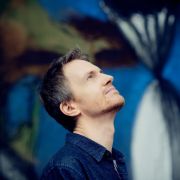
Was Johann Sebastian Bach the first minimalist composer? I would have thought the idea crazy until last night at the Royal Festival Hall, listening to Víkingur Ólafsson play in the UK premiere of John Adams’ latest piano concerto, named After the Fall. Written for the Icelandic pianist when he was in the thick of his worldwide tour of the Goldberg Variations, the piece has Bach running through its veins, haltingly at first and then in extensive quotes. It brings to life Bach’s resolution of the paradox of surprising inevitability: within an unchanging rhythmic pattern, the harmony continually shifts, sometimes as often as every bar, in a way that first surprises your ear by its daring and then immediately leaves you with the feeling that there was no other possible direction that this music could have taken. (Jazz lovers get this sense from Keith Jarrett’s The Köln Concert).


Adams enhances the effect with some brilliant orchestration and a carefully crafted dynamic arc. The piece starts gently with the glockenspiel, joined by other instruments contributing fragments of melody which are echoed by the piano: this is anything but a soloist’s showpiece in the mould of the traditional romantic-era concerto. The music builds steadily from there and the orchestral textures thicken until the intensity starts to accelerate as Ólafsson brings his full Bachian brilliance into play for a thrilling ending – “Bach takes off into outer space”, as he described it.
For Ólafsson’s encore, I’ll have to forgive the most shameless piece of name-dropping (“I just wrote this new arrangement for György Kurtag’s 100th birthday party last week”) because the said arrangement, of Bach’s Air on a G string, was nothing short of blissful – another demonstration of the surprising inevitability which leaves you utterly satisfied by each modulation.
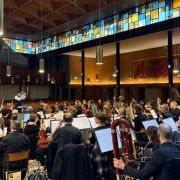
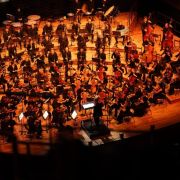
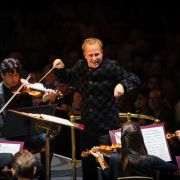
Esa-Pekka Salonen and the Philharmonia Orchestra were more than able partners in crime, with the conductor exercising millimetre control over dynamics and the many orchestral soloists producing delicious timbre in their various contributions, qualities that they continued to display after the interval, in the full ballet version of Ravel’s Daphnis et Chloé, joined by the wordless voices of a 90-strong Philharmonia Chorus.


Still, I have to wonder about the purpose of performing the whole ballet in concert. This is music whose intention is as a component of a dance performance, with a storyline that’s sufficiently fragmentary that you can’t really listen to the music with the visuals of each scene in your head, and few of the audience will have seen it danced (the only recent performance of the Fokine choreography in our records was in Toulouse for Ravel’s 150th anniversary last year). Last night, for all the marvellous sounds, it was difficult to get an overawing sense of the rapture of the lovers, the fear of the pirates or the awesomeness of the god Pan, and at little short of an hour long, I couldn’t suppress the thought that this was “effect without cause” (as Nietzsche contentiously described Wagner).
That changed with Part 3, which contains the ballet’s three famous showpieces that were each played with excellence. The chorus were magnificent in setting up the evocation of dawn, followed by which principal flautist Samuel Coles gave a thrilling performance in the Pantomime (the story of Pan and Syrinx), whose finger-shredding virtuosity must be exhausting, coming as it does after considerable numbers of flute solos earlier in the piece. The orchestra closed the evening in satisfying fashion with a rousing rendition of the Danse générale.