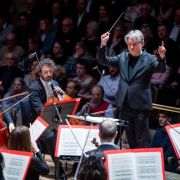
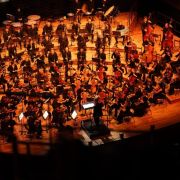
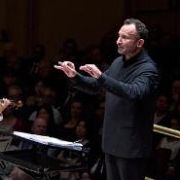
Since its 1956 Carnegie Hall debut under Carl Schuricht the Vienna Philharmonic has returned more than 115 times, the most of any international orchestra. During the 1985-86 season, they established an annual residency, known as the “Vienna Philharmonic Week in New York”. Since then their annual three-day visit has become one of the highlights of the season here. For this, the second in this year’s trio of concerts, Andris Nelsons conducted the New York premiere of a deeply contemplative homage to Pierre Boulez along with two exuberant symphonies, one by Mozart, the other by Dvořák.

The evening opened with Hungarian composer György Kurtág’s Petite musique solennelle en homage à Pierre Boulez 90. Written in 2015 to honor Boulez’s 90th birthday, the compact seven-minute piece became a memorial in addition to a birthday present when the French composer and conductor died in January of the following year. Responding to Nelsons’ animated and expressive podium style, the Philharmonic delivered a strikingly subtle rendition of the slow and haunting score, perfectly balancing the tensions between profoundly meditative passages and moments of poetic intensity to produce an elegant musical tribute. Memorable contributions included the masterful timing of the percussive effects (harp, cimbalom, tubular bells) and the warm, rounded timbre of the horn section.


The Vienna Philharmonic players always display a unique and special sound when playing Mozart. Under Nelsons’ satisfyingly paced baton, they delivered an exhilarating, yet warm-hearted interpretation of the remarkably sophisticated Symphony no. 36 in C major, known today as the “Linz”, written in just four days during a 1783 stopover in that city. After a spirited and lively opening Allegro spiritoso came a heavenly version of the Andante, perfectly balancing the music’s graceful, singing qualities with the novel modulations of the trumpets and drums. A regal and rhythmically Menuetto, marked by exquisite woodwind phrasing, led into an exuberant, dance-like finale, bringing everything to a brilliantly ecstatic close.
The announced program concluded with Dvořák’s Sixth Symphony, widely viewed as his breakout work but less often heard than his Seventh, Eighth or the phenomenally popular Ninth. It was composed in 1880 for the Vienna Philharmonic at the request of Hans Richter but, due to the musicians’ objections to Czech music, its premiere was moved to Prague in 1881 where the Czech Philharmonic debuted it under Adolf Čech. An 1882 London Philharmonic Society performance conducted by Richter brought Dvořák to international attention, but it wasn’t until 1942 that the Vienna Philharmonic performed it for the first time.

On this occasion Dvořák’s high-spirited music was well served by Nelsons in an exuberant account, bursting with Brahmsian qualities and Bohemian folk rhythms. The alluringly pastoral Allegro first movement, taken at a finely judged tempo, with the woodwinds dazzling throughout, displayed a captivating rhythmic drive. In the intimate, almost chamberlike Adagio, Nelsons emphasized the sweet, songlike lines of the upper strings and the pastoral qualities of the gorgeous woodwinds. A wildly energetic Scherzo, based on a Czech folk dance (the Furiant), led into a light and delicate interpretation of the Trio, another pastoral showcase for winds. In the heavily orchestrated finale, Nelsons masterfully navigated the complex structure, allowing the music to flow and build to a thrilling and joyful conclusion.


As an encore, the audience was treated to a nostalgically elegant Viennese waltz, Josef Strauß’s Mein Lebenslauf ist Lieb und Lust.