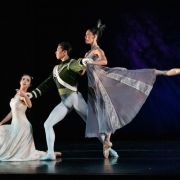
Jerome Robbins’ deeply humanistic Dances at a Gathering paired with George Balanchine’s opulent Diamonds yielded much to marvel at this past week, in a winter season already glittering.

Among the stellar crew of ten in Dances at a Gathering, five dancers new to the ballet settled in with the assurance of old hands. In a galvanizing performance as the man in purple, Ryan Tomash exuded great warmth and landed his double tours en l'air in a deep knee bend with panache. His encounters with Tiler Peck in pink brought the ballet’s emotional core vividly to life: in their first mazurka she radiated delight, her legs inscribing bold arcs as he piloted her through the air. The mood shifted when they met again in the eye of the storm of the climactic Scherzo, making shelter for each other. She stretched out a leg in yearning and fell back into his arm; he slid her along the floor and sustained her through exquisite, unhurried revolutions.


Mira Nadon was heartbreakingly lovely in mauve, ushering in the storm with a stunning series of spins, firing off extensions like lightning bolts and flinging her arms with expressively broken wrists. Her whirling hops evoked the chill of Giselle’s emergence from her grave; her encounters with the sterling Adrian Danchig-Waring in green slipped from rapture into shadow, as if one of them were now dancing with a ghost.
More brilliant turns from Emma Von Enck as the windblown woman in apricot and David Gabriel in brick, who matched her insouciance in Chopin’s spirited Two-Four Waltz. They leaned into the comedy – like the lift which landed her sideways across his shoulders; she yanked her free arm overhead as he carted her around like lumber. In her restless solo, Von Enck seemed ready to outpace the heroic Hanna Hyunjung Kim at the piano. Hers was a flintier, more brittle yellow, brushing off the lyrical suggestions written into score and dance – captivating nonetheless. The house roared when she spun in the air and landed upside down in Davide Riccardo’s welcoming (blue) arms.

Also debuting, Ashley Hod in blue wove lightheartedly through everyone else’s lives and formed an exquisitely attuned trio with Nadon and Peck in the Valse Brilliante. Together they flickered between naive anticipation and weaving – like the mythological Fates – the threads of other people’s destinies.
This was not the first rodeo for Roman Mejia, a magnetic presence as the man in brown who opens the ballet with a yearning, enigmatic mazurka for one. Folk dance inflections fluidly unspooled into the balletic with unforced technique and phrasing that breathed – both here and in his exuberant duet with Peck.
Megan Fairchild, who retires in May, danced the seasoned artist in green in a syncopated, bristling étude full of expressive shoulders and frangible tendus that evoked a once-illustrious career. Overlooked by the men, she rightly concludes that all along she has been enough.

Robbins’ dancers seem to dance for one another rather than for us; in the closing Nocturne they practically denied the existence of the audience altogether. After watching something momentous move across the horizon – a distant tornado; a missile interception – they strode downstage and stared past us. Edward Villella recalled Robbins asking him to imagine it was the last time they would ever dance in that space, perhaps on the brink of catastrophe, the atom bomb falling. There was something strangely consoling in the way they seemed to shrug off whatever loomed, bow gravely to one another, and pair off for a stroll.


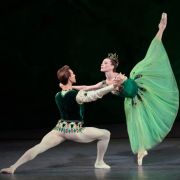
Nothing could be farther from the intimate, suspended world of Dances at a Gathering than Diamonds, with its surface glitter, the lapidary precision of its ballerina’s quicksilver lines and frosty imperial Russian grandeur made literal by baubles on tutus and tunics and dangling from the rafters.

After an uninspired first movement, the imperial machine achieved liftoff with the arrival of Sara Mearns and Tyler Angle, who approached one another obliquely in a ritual of diplomacy – two sovereigns negotiating alliance, their jewel-encrusted torsos flashing like twin dashboards on a spaceship. Their encounters crackled with danger: every step she took onto pointe, every sweep of the leg, every plunge and backbend fully risked. She scarcely looked at him, and he did not hedge – hovering nobly yet offering no more aid than the moment required. The restraint was thrilling.
This wasn’t a showy performance as much as it was deeply felt. The pair emerged from their initial deliberation triumphant – a crisis of state averted. Pageantry ensued, led by the authoritative quartet of Nieve Corrigan, Meaghan Dutton-O’Hara, Ruby Lister and Mary Thomas MacKinnon. Mearns coursed across the stage, back arched, drawing an imaginary bow; she spun on pointe and in the air, reckless yet controlled. Her constituents massed on stage, amplifying the pomp, until the final tableau, with Angle yielding on one knee.