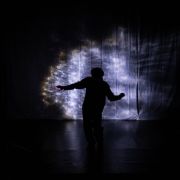
Remorse takes centre stage in Jean-Christophe Maillot’s cinematic Roméo et Juliette, which unfolds as one long flashback through the tormented memories of Friar Laurence. His efforts to reunite the young lovers ended in their deaths, leaving him overwhelmed with guilt. The ballet opens with film-style credits projected onto a semi-transparent screen at the front of the stage, which reappears at the beginning of each act as a window onto Friar Laurence’s recollections. Each time, his mouth opens wide in a silent cry of despair as spectres from the past come to life.

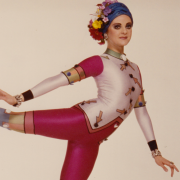
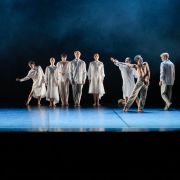
Yet, for all this sorrow, the ballet is full of contrasting emotions and bursts of humour, with choreography so vivid that even a handful of dancers can conjure up the chaotic bustle of Verona’s streets. Renaissance pomp gives way to movable white geometric structures by Ernest Pignon-Ernest, while Jérôme Kaplan dresses the Montagues and Capulets in black and white, like opposing sides in a game of chess. Created with his longstanding collaborators, Maillot’s Roméo et Juliette has been performed hundreds of times around the world and now returns to the Salle Garnier for its 30th anniversary. Prokofiev’s score, performed live at the 1996 premiere, is unfortunately recorded this time.


Everybody dances, with almost no pantomime. And in Les Ballets de Monte-Carlo they do so particularly well, thanks to the exceptional calibre of the company. Even the Dance of the Knights is no stiff display of solemnity, but a real ball, with couples rushing across the stage and women floating through the air. The Nurse (Lydia Wellington) delights with her quick, scurrying steps and comic antics, while Marianna Barabas is an imposing and cunning Lady Capulet, with high extensions and commanding angular lines. As Friar Laurence, Jaat Benoot conveys the weight of his conscience through a contrast between solemn gestures and airy leaps, his anguish amplified by two acolytes (Zino Merckx and Kozam Radouant), who move like white wings at his sides.

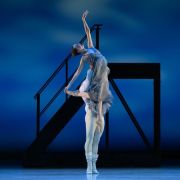
Juliette Klein is an impressive, rapidly maturing talent, enriching her portrayal of Juliet with lyricism, technical prowess and beautifully extended lines. Francesco Resch as Romeo convincingly evolves from a carefree womaniser into a reckless lover. Their youthful passion finds its fullest expression in the balcony pas de deux. A white opening bathed in a beam of light becomes a slide down which Juliet glides gracefully. The moment when Romeo, catching sight of her beauty, lets his jacket fall to the floor is wonderfully moving in its simplicity. The duet is a whirlwind of running, chasing and vertiginous lifts. Together, they capture the playful, uninhibited joy of the lovers so beautifully that you find yourself longing to fall properly in love.

Back to the street brawls, Simone Tribuna is a powerful and fearsome Tybalt. Dillon Brizic makes for such an alluring and sprightly Benvolio that he might have been even better cast as the more mercurial Mercutio (Ige Cornelis). Mercutio’s death is pure cinema, with the killing and the ensuing reactions of the two rival groups unfolding in slow motion. Particularly touching is the moment when Romeo, having killed Tybalt to avenge his friend, suddenly becomes a boy again, hanging his head in dismay like a child who has just lost a football match, so vulnerable and tender that you want to comfort him.


The bedroom pas de deux is at once sensual and abstract, with Juliet barefoot and uninhibited, and Romeo lost in his love for her, their bodies expanding and contracting like the beating of a heart or the opening and closing of a flower. Even the formidable Lady Capulet finds her authority shaken by Juliet’s temperament. When she arrives with Paris, played with considerable theatrical flair by Alejandro Moya Vaquero, Juliet throws a tantrum and gets into a scuffle before her bewildered suitor. With a gesture of helpless resignation, Lady Capulet conveys the relatable frustration of a mother who no longer knows what to do with her rebellious teenage daughter.

Thirty years on, Maillot’s reading of Shakespeare retains a certain timelessness, not least for its refreshing refusal to depict the action literally. Weapons, potions and other props are largely dispensed with, allowing dance to express the drama in full. Juliet dances with Friar Laurence and his assistants before falling into her deathlike sleep, as though under some mysterious, almost mystical influence. Romeo runs towards her and collapses at her feet. Juliet, in turn, delicately strangles herself with a red ribbon that she draws from her lover’s heart. The lovers are dead, and Friar Laurence leans against a wall, consumed by remorse and despair. Even now, he cannot help making their tragedy about himself.
Elsa’s trip was sponsored by Les Ballets de Monte-Carlo