The Royal Ballet's Draft Works initiative began as platform for the company’s own dancers to show incipient choreography skills: somewhere they could experiment with their ideas and craftsmanship skills and see the results on stage in front of an audience. Since then it has become International Draft Works, featuring choreographers from around the world, and giving us the chance to see dancers from companies we would not normally see in London. Last year a curated special edition for Black History Month produced some memorable work of astoundingly mature insight.

The latest incarnation brought much to delight; in some cases this had more to do with the performances than the choreography itself, but there were some pieces that moved or cajoled us with real artistry.
The opening piece, Staves by Heather Lehan, was somewhat disappointing. Two excellent dancers from Northern Ballet (Archie Sherman and Noah Benzie-Drayton, cavorted in mish-mash costumes (tailcoats with black lycra shorts and black socks – not a good look) to music from Eine Kleine Nachtmusik, and although this was fun and lighthearted, it failed to bring anything of long-lasting interest to the table. The same could be said of Yoshito Kinoshita’s Re:sonance, danced exquisitely by Ryosuke Morimoto and Haruka Soutome of the National Ballet of Japan. There were some nice melting moments of lyricism but on the whole the choreography reflected the blandness of Ludovico Einaudi’s Low Mist music.


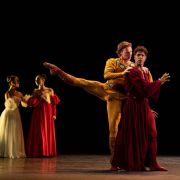
I was intrigued to see how two pas de deux extracted from Flux by Katya Bourvis for Ballet d’Jerri would fare. The ballet in full is based on the Jersey witch trials of the sixteenth century. In the first pas de deux, we see a couple (Tabitha Dombroski and Stanley Young) in pale, shining costumes, portraying a glowing spiritual power; in the second, a witchy tease (Anna Daly) flirts and taunts a seemingly less-than-willing suitor (Donovan Délis-McCarthy), showing the progress of an independent woman living life on her own terms to persecution for her refusal to conform.

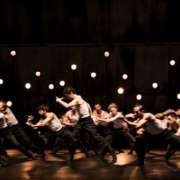
Both pas de deux were beautifully made and very well danced. They were also exquisitely lit by Joshie Harriette, whose clever effects melded intuitively with the choreographic intentions. Harriette’s work (he designed the entire evening) came into its own again at the end of the programme, in un:discovered by Douwe Dekkers of Norwegian National Ballet. This started out somewhat derivatively but soon developed into an interesting, superbly crafted piece with satisfyingly broad movement, filling the stage even with only three dancers. Harriette’s downward beams of light, crossing each other in arresting patterns, complemented the feeling of breadth and openness conveyed by the dancers, Simon McNally, Nell Ramstad-Pedersen and Silas Henriksen.
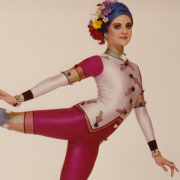
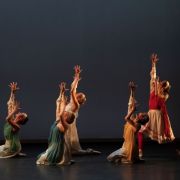
Sarah Foster-Sproull’s Ultra Folly was another fun piece with no particular message other than sheer joy in dancing. Three couples, all dressed in brightly coloured skirts, sleeveless shirts and ruffs, expressed the pleasure of the company of friends with humour and love. Pointe shoes appeared in this piece for the one and only time during the evening.

The Royal Ballet’s Denilson Almeida, progressing steadily as a dancer, showed Words to the Wind, spectacularly well danced by up-and-coming stars Martin Diaz and Caspar Lench. With a cast like this the piece could not fail to succeed, and I admired Almeida’s choice of Brazilian rhythms with overtones of African religions.


Alyssa Martin says in programme notes that her Gush is “a bacchanalian pas de deux for two women and the things that make them sweat”. Martin’s background is in contemporary rather than classical work I believe, but her style is beautifully expressed through the classical bodies of the National Ballet of Canada’s Tene Ward and Agnes Su, two dancers who have that enviable quality of apparent bonelessness. Martin chose a brilliant Meredith Monk score too.

Carling Talcott-Steenstra chose to use older character dancers from the Royal Danish Ballet for his piece, Houndstooth. I found the voiceover for this so intriguing that I waited excitedly for the movement to reflect it, but sadly there was no discernible connection, so although the dancers were excellent it was, for me, unfulfilling.
I was most impressed by À perte de vue et au-delà (Beyond what the eye can see) by Paris Opera Ballet’s Maxime Thomas, danced by himself and Guadeloupian paraplegic dancer Gladys Foggea. These are two dancers with singular stage charisma, with the power to draw one in to their shared experience of mutual respect and tenderness. The ingeniousness of the manoeuvring of Foggea’s wheelchair, as Thomas’s body arced and wheeled around it, left an imprint on the mind’s eye, and their skill in communicating their mutual love and respect was emotionally stirring and meaningful.