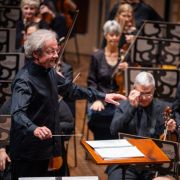
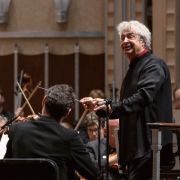
Approaching the end of the penultimate season of his quarter-century tenure as The Cleveland Orchestra’s Music Director, Franz Welser-Möst led a varied program that highlighted his specialties. Though without a clear common theme, it moved from strength to strength, reflective of the threads he has emphasized throughout his Cleveland years. One of the conductor’s more interesting undertakings has been performing and recording the complete Prokofiev symphonies. A reprisal performance of the Classical Symphony made for a pearly opener.

Effervescent from the beginning, it was refined while subtly subversive to the classical style with its piquant chromaticism. Strings were light and airy, articulated with crisp precision. The lumbering Gavotte perhaps could have had a more caustic edge, but all cares were left aside in the fizzy finale, as witty as anything Haydn wrote.


As composer, conductor and clarinetist, Jörg Widmann has found a great champion in Welser-Möst. He served as TCO’s composer-in-residence from 2009-11, and his scores have continued to be programmed here. Last week, Widmann led his own music from the podium; this week, he shifted gears and served as soloist in the US premiere of Zones of Blue by Welser-Möst’s Austrian compatriot, Olga Neuwirth. The name alludes to a poem by Tennessee Williams and also acknowledges the composer’s late father, eminent jazz pianist Harald Neuwirth.
Subtitled Rhapsody for Clarinet and Orchestra, the 20-minute work unfolded as a stream of consciousness, in a myriad of abstractions. Breathy sounds from the solo clarinet coalesced almost imperceptibly with the orchestra to set matters in motion. The iconic clarinet opening of Rhapsody in Blue was obliquely suggested; other melodic fragments seemed to be a dreamy evocation of a smoky jazz hall, only to veer off into tones barely recognizable as emanating from the clarinet. Percussive splashes punctuated with force, a vast arsenal that included Thai gongs, flexatone, water gong and piano tuned in microtones. At the end of phrases, Widmann would gesture emphatically with his left hand, a physical manifestation of the intensity with which he played. The work closed abruptly on a sharp fragment, as if frozen in time.

Opera and the Austro-Germanic repertoire have also been key focus points for Welser-Möst. The two were accounted for in what amounted to a 40-minute symphonic suite from Wagner’s Götterdämmerung, the final installment of the Ring cycle. At the opposite end of the spectrum from the economy of Prokofiev’s Classical, the orchestra swelled to expansive proportions. Dawn opened with a searching unease, calmed by the amber warmth of the brass and the resonant clarinet (Afendi Yusuf) and the full strength of the orchestra was marshaled for a radiant sunrise.


In Siegfried’s Rhine Journey, one could almost feel the flow of the mighty river. Marked by a vivacious horn call (Nathaniel Silberschlag), the music was as haughty and headstrong as Siegfried himself. The brilliance of Wagner’s orchestration was on full display, deftly blended under Welser-Möst’s baton, without tipping into excess despite its density. Ominously pulsing drums opened the Funeral March ahead of its shattering plunge to darkness. It built to a majestic climax, of palpable heroic weight. In the Immolation Scene, Wagner had the daunting task of suitably closing such a monumental conception. Tension was slowly built before its ferocious descent. Flames danced, the river overflowed, Valhalla fell and love reigned supreme in this music of vivid imagery.