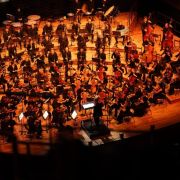
To witness Franz Welser-Möst at the end of this concert, you wouldn’t have thought he had just conducted Shostakovich’s granitic Eighth Symphony. Not a hair was ruffled, not a bead of sweat broken. His beat is airy, his hands rarely rising above eye level. Mute the sound and he could have been conducting a Strauss waltz. He is possibly the most undemonstrative conductor I’ve seen on a podium, yet the responses he drew from The Cleveland Orchestra were razor sharp; the smallest gesture capable of triggering the fiercest fortissimo.

This is Welser-Möst’s 25th and final season as Music Director of the Clevelanders, thereby passing George Szell’s 24-year tenure (1946-70) and turning him into their longest-serving chief. Nearing the end of a 15-concert European tour of 12 cities, from Hamburg to Athens, they play three concerts in Vienna – where Welser-Möst is revered – two at the Musikverein, one at the Konzerthaus.


This second Musikverein date began by topping and tailing Richard Strauss’ Daphne, an opera Welser-Möst has never conducted across the Ringstraße at the Staatsoper. The Introduction and closing Transformation Scene, where Daphne is turned into a laurel tree to escape lustful pursuit of the god Apollo, make a satisfying 20-minute suite. TCO has long had a reputation as the most European-sounding of American orchestras and their warm, sweet strings and soft-edged, buttery horns fit the Musikverein like a glove. But the star of Strauss’ bucolic music was Frank Rosenwein, long-standing Principal Oboe, whose pastoral tendrils unfurled with a honeyed tone. Silvery strings harmonics cast a moonlit shimmer over the closing pages, Concertmaster Joel Link supplying Daphne’s wordless vocalise.
Dmitri Shostakovich described his wartime Seventh and Eighth Symphonies as his Requiems. The Seventh was celebrated for its defiance in the face of the Nazi invasion of Leningrad, but the Eighth, written in 1943, is bleak, a “poem of suffering” according to the composer and as much about the suffering of Soviet citizens under Stalin as any alien forces. The symphony was condemned by Andrei Zhdanov, Minister of Culture, who likened it to “a piercing dentist’s drill, a musical gas chamber”, and it was officially censored and withdrawn in 1948, the scores ordered to be recycled, recordings destroyed.
From its foreboding opening string motif, the Clevelanders’ performance of this sombre score was relatively brisk (60 minutes) and business-like. Welser-Möst’s Shostakovich doesn’t heave or pant – there were times in the two scherzos where a more violent bite would have been welcome – but his journey across its five-movement arc was expertly navigated. The conductor’s intimate knowledge of the Musikverein’s acoustic was paramount to its success. Welser-Möst knows exactly where the dynamics of Shostakovich’s furious climaxes can overload the hall, yet the sound never congested.


The performance also showcased The Cleveland Orchestra’s outstanding principals: Robert Walters’ full-bodied cor anglais lament in the lengthy first movement; Nathaniel Silberschlag’s mellow horn in the bleak fourth; Assistant Principal Catherine Van Handel’s jocular bassoon that opened the finale. The woodwind section was exceptionally fine, punctuating the second Scherzo’s motoric toccata with wild shrieks while the nine double basses fired their pizzicato shots like a bow releasing an arrow.
The Clevelanders have a history of meticulous conductors who demanded technical perfection, creating an enviable legacy. Szell was still getting great reviews decades after he died. Twenty years from now, I hope Welser-Möst is still being credited for preserving this orchestra’s very special qualities.