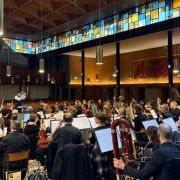
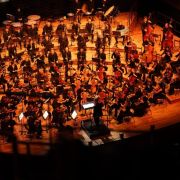
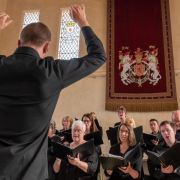
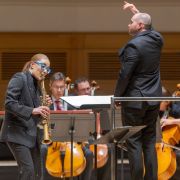
‘Is Wynton Marsalis on the platform?’ whispered the lady sitting next to me. In a sea of over 200 performers on the Usher Hall stage for his gargantuan jazz symphony All Rise, from the stalls it was even difficult to locate the grand piano with so many musicians placed in front, but there Marsalis was, trumpet at the ready, right in the middle of his Jazz at Lincoln Center Orchestra players, massed in front of conductor James Gaffigan. The Royal Scottish National Orchestra surrounded the jazzers with the Edinburgh Festival Chorus and Jason Max Ferdinand Singers filling the choir stalls, the combined forces a thrilling sight.

This signature work has inspired the 79th Edinburgh International Festival’s overarching theme, celebrating the 250th anniversary of the Declaration of American Independence, the visiting Americans here heralding a busy Festival line-up. All Rise is a rallying cry encompassing collaboration, resilience and ascendance, a bold examination of the dark and dazzling possibilities of the American Dream cultural melting pot, a theme unquestionably embodied in this opening concert.


Written as a Millennium piece, All Rise in its 12 blues-based movements traces all of human life: a journey from birth, play and self-discovery, through pain and sacrifice to maturity and joy. Although Marsalis echoed Mahler in what a symphony should embody, All Rise with references from blues to funeral band, gospel hall to fiddler’s reel, sets its own path as classical melds with jazz in a signature work of humanitarian faith.

Gaffigan stitched all the component parts together, the opening Jubal familiarising the audience with the sound world, classical angular violins, deft syncopations keeping the team of percussionists very busy while Marsalis’ players breathed Ellingtonian phrases and singers opened with a rhythmic chant. The joyful A Hundred and a Hundred and a Hundred and Twelve balanced forces across the piece. The sunny, mellow Go Slow (But Don’t Stop) had the RSNO players and warm woodwinds setting off in a dainty waltz, the jazz orchestra cooking this up into a driving four-beat swing. Wild Strumming of Fiddle ended this first group with an energetic workout for the RSNO strings, like a strange hoedown, the open string timbre excitingly toe-tapping.

The central set of four movements was more sombre and poignant, and the most powerful. A sudden choral shout took us into the biblical, the music swinging in alternate beats, Marsalis taking an epic trumpet solo. Best of all were Cried, Shouted and Sung and Look Beyond which had tremendous gospel singing from the Edinburgh Festival Chorus, solos taken by Jason Max Ferdinand Singers, all so gripping that we might have been at a revivalist meeting. The brass shrieked interjections, the players stamped their feet in unison, trombones providing a New Orleans feel. The slow bluesy Look Beyond chant had a mesmerising fade-out, the jazz players applauding the choir.

The final four movements took us into dance, whoops to a Latin beat, the front desk of the jazz orchestra deftly swapping instruments from saxophones to clarinet and flute. A train journey and slow shuffle of Saturday Night Drag took the work to its big choral I Am conclusion, but then a coda with the EIF Chorus, scores down, singing a heartfelt New Orleans parade song.

All Rise is a work of many highlights, sprawling at times, but Wynton Marsalis was beaming when taking his bows, a significant milestone for him as he steps away from the Jazz at Lincoln Center Orchestra after four decades. In a Festival touch, the Scottish National Youth Jazz Orchestra played New Orleans standards on the Usher Hall steps, marching us all outside at the end. Great fun.