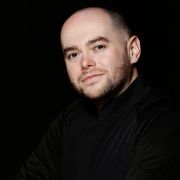
Yunchan Lim and Marin Alsop regularly dispel the notion that lightning doesn’t strike twice. At this point, the pair have generated enough electricity to start a forest fire. After winning the Van Cliburn International Piano Competition together in 2022, they’ve returned frequently to Rachmaninov’s Piano Concerto no. 3 in D minor, their valedictory show piece. The most recent outing took place last weekend with the Philadelphia Orchestra, where Alsop is Principal Guest Conductor, and where Lim demonstrated again a sovereign and highly personal account of this familiar work.

The 22-year-old pianist dispatched any suggestion of dealing solely in grandiosity with the opening melody of the Allegro ma non troppo, which was contemplative to an almost monastic degree. With almost staccato-like phrasing, notes hung in the air like question marks. No sooner had he shown his simple side did he display how quickly he could vary the mood, bounding into the cadenza with the speed and dexterity of a gunslinger. This was a case study in controlled chaos, where the listener felt the music could easily slip through his fingers at any moment, but the sense of domination was never lost. Lim executed his transition back to the wistful opening statement at the end of the movement with minimal fuss, as if summoning a pleasant memory amid a rollicking storm.


Lim’s lushly evocative reading of the Intermezzo theme provided lushness without schmaltz, but other moments in the second and third movements seemed dicier. The issues largely arose in the orchestra, with Alsop not always perfectly managing entrances and transitions. Although the middle section moves without pause into the finale, Alsop had a tendency to close up rests within movements, which created the air of a steeplechase. Lim occasionally seemed out of sync as the Finale progressed, with the orchestral accompaniment growing in volume and intensity, but he managed to make even the odd dragging phrase seem like an artistic choice. And it’s ignoble to complain when the overall tone, color and phrasing are at this high a level.
After receiving the kind of applause one might expect to be reserved for Taylor Swift or Harry Styles – the sea of cell phone cameras raised throughout Marian Anderson Hall deserved a photograph itself – Lim teamed with Alsop to provide a verbatim encore: returning to bench and podium, they repeated the last five minutes of the Finale: Alla breve, which sounded more coordinated and compatible without its galloping leadup.
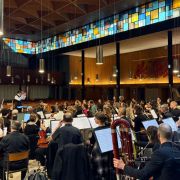
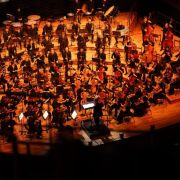
Alsop perhaps intuited that a majority of the capacity audience came for Lim, so she wisely placed the Rachmaninov at the end of the program. She stacked the first half with two works she has widely performed elsewhere, her familiarity and reverence demonstrated by conducting both from memory. If the famous Philadelphia string sound seemed a tad too homogenized early in Samuel Barber’s Symphony no. 1 in One Movement, their requisite opulence proved exactly right as the piece moved toward the Romantic territory for which the composer would become known. Peter Smith played the oboe solos with humor and pathos, as required. The Stravinsky Firebird Suite was boisterous and pleasant throughout, if lacking a sense of mystery in the quieter sections.