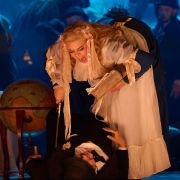
When Franco Zeffirelli was invited to stage a new production in the tiny theatre in Busseto to mark the centenary of Giuseppe Verdi’s death in 2001, the powers that be could hardly have expected him to choose Aida! Mention Zeffirelli and Aida in the same breath and the mind conjures up spectacle on a gigantic scale – think of La Scala or the Arena di Verona and its 15,000 spectators. Busseto’s Teatro Verdi seats around 300 and the stage is just seven metres wide. Yet it proved a triumph and, 25 years on, the Festival Verdi has now revived it.

The Busseto stage is small but Zeffirelli’s sets are monumental. Giant statues of Anubis and Sekhmet dwarf the cast, pillars tower and, for the Triumphal Scene, a pyramid looms on a backcloth. Everything is studded in hieroglyphs. Anna Anni’s costumes are exquisitely detailed – even the off-stage Priestess (Nicoletta Briguglio) had a costume! Zeffirelli’s budget must have been enormous. The three intervals were at least partly necessitated by set changes, meaning the curtain didn’t come down until nearly midnight.


And spectacle? A chorus of 30 plus a handful of extras (guards in blue-face!) mean there’s not much stage space for a Triumphal March, so Zeffirelli brilliantly subverts expectations and has the audience behind the crowd as they jostle for position and look upstage at a procession that we cannot see. The only singer facing us is Aida and so we focus on her anguish. Although the Act 2 ballet was cut, a Carabosse-like dancer (Giorgia Ricciardi) with spiky hand movements appeared as a priestess in the Act 1 ballet.

For all its spectacle, many scenes in Aida feature only one or two singers and the intimacy of the Teatro Verdi helps bring those scenes vibrantly alive. Zeffirelli chose young singers for his 2001 cast; revived by Stefano Trespidi, a similarly young cast responded with dedication and spirit.

Federica Vitali impressed in her role debut as Aida. She’s a lyric soprano although strong chest notes indicate a possible spinto future. Her initial phrases were a bit nervous, but she soon settled to give an assured “Ritorna vincitor!”, ending with a tender prayer, poised without resorting to histrionics. The Nile Scene, a symphony in blue in Zeffirelli’s vision, was graced by her moving, unforced rendition of “O patria mia”, floating high notes beautifully apart from a slightly snatched top note, followed by a crackling duet with Korean baritone Hae Kang’s powerful Amonasro where you could see the whites of their eyes flashing. Everything about Vitali’s performance was imbued with great sincerity.

Vincenzo Costanzo’s Radamès relied more on stock gestures and a bullish vocal presence. He was announced as indisposed before the performance, yet attacked “Celeste Aida” with can belto verve, his tenor baritonal, but with a strident top. By Act 3, he was vocally tiring and ducked a phrase or dropped his voice an octave here and there. He kept going but looked properly disconsolate at the curtain call – my heart went out to him.


The most experienced member of the cast, with a strong background in bel canto, Teresa Iervolino turned in a fabulous Amneris, imperious in manner but also a credible love interest for Radamès (in Zeffirelli’s vision, there has definitely been a romantic liaison). Iervolino has a warm mezzo tone without it being a huge instrument – it’s not a role she should necessarily attempt in a large opera house – and she flung herself at the Judgement Scene with passion. Of the minor roles, Alberto Comes’ bass was a bit woolly as Ramfis, Adriano Gramigni was firm-voiced as the King and a shout-out to young tenor Francesco Congiu in his brief solo as the Messenger, vividly phrased.

As well as Vitali and Iervolino, the evening’s other star was in the pit. Still in his early 30s, Giuseppe Mengoli, winner of the 2023 Mahler Conducting Competition, worked up a sweat driving the Filarmonica Arturo Toscanini – whose namesake conducted in this house – through Verdi’s score in thrilling fashion. Space was at a premium; the harpist was in a box and the percussionist playing bass drum and cymbals was visible through the pit door, crouching to see the conductor! Mengoli’s pacing was superb – the accelerando at the end of Act 2 was spinetingling – yet he also gave space for his singers to phrase naturally.
I’ve been fortunate enough to witness opera in some pretty incredible locations, but in terms of thrills, experiencing this production up close and personal rises to the very top.