‘Mondi lontani’ (Distant Lands) is the theme running through this year’s Festival Verdi in Parma. It stages three operas this edition set in far-flung locations that, in Verdi’s day, would have been considered “exotic”, a loaded word in today’s world that charges composers with cultural appropriation and calls for their operas to be cancelled. Aida and Nabucco are staples of the repertoire, but Alzira is a true rarity.

In a prologue and two acts lasting all of 90 minutes, Alzira is a tiny opera, often dismissed as insignificant. Even Verdi was purported to describe it as “Quella è proprio brutta” (This one is really ugly) and never revisited it. Based on Voltaire’s 1736 play Alzire, ou les Américains, the opera is set in 16th-century Peru occupied by Spanish conquistadors, hence themes of colonial violence and the plundering of the land’s natural resources in Manuel Renga’s simple, but sympathetic production.


The title character is the daughter of an Inca king, used as a political bargaining chip, offered in marriage to the new Spanish governor, Gusmano, to secure peace. But that reckons without Zamoro, leader of a Peruvian tribe, who is in love with Alzira. In the Prologue, Zamoro shows clemency to Alvaro, Gusmano’s father and former governor, which stands him in good stead when in peril later (Zamoro has an unhappy knack of getting himself captured). After Alzira has agreed to marry Gusmano to secure her lover’s freedom – more bargaining – the wedding is crashed by Zamoro, believing Alzira has been unfaithful to him, and he shoots the governor. As he dies, Gusmano reveals the truth and blesses the couple.

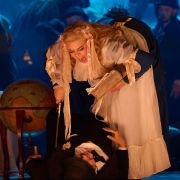
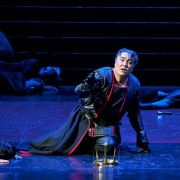
Renga and his designer Aurelio Colombo set the action in three distinct spaces: a museum or gallery decked with Spanish portraits and plundered treasure; an arid, rocky landscape with a pit which, all gold having been mined, now doubles as a grave; and a blank apron across the front of the stage, which seems to symbolise Alzira’s purity. Into this white space appear her spirit ancestors and a giant sunflower, representing her purity. It eventually morphs into a leaden monument to her people until, with his dying breath, Gusmano daubs its petals in gold.
Costumes are a strange mix of 19th-century formal attire and 16th-century doublet and hose for the Spanish grandees, although that never troubles the eye. For her wedding, Alzira is decked out in black gown and golden crown like the Madonna in a Catholic Easter procession.


Vocal performances ranged from decent to strong. Marta Torbidoni, announced before Act 2 as indisposed but continuing to perform, made a fine Alzira. She displayed a fiery attack – which sometimes threatened to veer off the rails, but never quite did – and a good, tight trill, evident in her cabaletta. Daniel Luis de Vicente sang a robust Gusmano, with a juicy baritone, albeit his Italian laced with a thick Spanish accent (not inappropriate for his character).
The revelation was Antonio Poli, who’s come a long way since his Don Ottavio when Kasper Holten’s Don Giovanni production premiered. Mozartian lightness has grown into a dashing tenor with some really exciting top notes and a winning charisma.

Alessio Cacciamani sang firmly in the minor bass role of Alvaro, although it’s tempting to think how much more Verdi might have made of this sympathetic character had the opera come later in his career. Other minor roles were confidently taken. The Coro del Teatro Regio di Parma sang with fire, although much of what Verdi offers them is fairly trite.
James Conlon conducted with plenty of pep, his tempi considerate to his singers, and the orchestra responded with lively playing to demonstrate that Alzira, although no neglected masterpiece, is certainly worth the occasional outing.