La traviata holds legendary status at the Teatro alla Scala. Following Luchino Visconti’s iconic production for Maria Callas in 1955, the opera was respectfully left untouched for nearly a decade. When revived in 1964, the outspoken loggione had the audacity to boo Mirella Freni (for the crime of not being Callas). The Scala management dared not attempt another new staging until 26 years later, when Riccardo Muti boldly set out to strip Verdi’s popular trilogy (Traviata, Rigoletto, Trovatore) of traditional encrustations. He presented the opera unabridged and faithful to the score, alongside director Liliana Cavani’s splendid staging, which strictly follows the libretto.

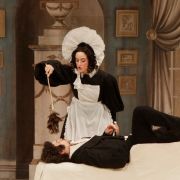
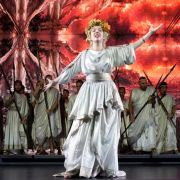
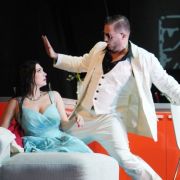
Cavani evokes an exquisitely decadent world: 19th-century Parisian high society immersed in lavish parties and cynical, hypocritical morals. Dante Ferretti’s gorgeous sets, Gabriella Pescucci’s sumptuous costumes and Andrea Giretti’s warm, soft lighting lend the narrative a fairytale quality. With towering windows, the enormous bed where Violetta lies dying, and the pastel gowns of Act 1, it feels like Cinderella gone wrong. In contrast, Act 2’s countryside retreat feels more human as the lovers experience genuine affection, while Flora’s party – dominated by deep reds, blacks and ominous bird masks – reads as a dark celebration of debauchery, mirroring Violetta's tragic regression to her old life. Cavani’s attention to detail is meticulously crafted: during the frantic opening party, every character moves with precise intention (a rarity nowadays), while in Act 3 the Parisian carnival flickers subtly outside a window.


This production has been revived numerous times, briefly interrupted by Dmitri Tcherniakov’s disastrous take that opened the 2013-14 season which was swiftly shelved. With this run, Cavani’s staging reaches its 100th performance. While an institution like La Scala must innovate, one hopes this production returns periodically for years to come – new audiences deserve to experience it.

The La Scala Orchestra lives and breathes this music, infusing it with deep emotional weight. Conductor Michele Gamba offered a slow, mournful prelude that felt like a bittersweet memory before driving the opening party at a whip-smart pace with swirling winds. He maintained steady tension throughout the heartbreaking moments and conducted Act 3 with restraint, avoiding sentimentality and allowing the score to speak for itself. The chorus performed with its signature precision and musicality, delivering a deeply emotional, intense rendition of the Act 2 concertato, forcefully guided by Gamba's steady hand.
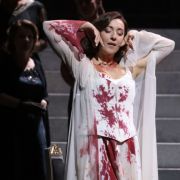
Nadine Sierra, a celebrated Violetta across top global opera houses, brought great commitment to the role. Her soprano showcased a golden hue, rich mid-range power and remarkable top-register agility. Her coloratura was crisp and high notes secure – including a beautiful high E flat at the end of “Sempre libera” – though predominantly loud: the absence of filati slightly muted the emotional impact. Minor intonation wobbles occurred, and her breath technique occasionally compromised her legato (notably in “Dite alla giovine”). However, her Act 3 was deeply poignant, featuring a remarkable “Addio, del passato.” Overall, a strong performance in a treacherous role.

Piero Pretti proved ideal as Alfredo Germont. His lyric tenor burst with youthful passion across Acts 1 and 2, bringing a cruel heroism to Violetta’s humiliation at Flora’s party. With flawless breath control, masterful legato and pristine bel canto technique, his high notes sounded effortlessly placed – even as he opted out of the unwritten high C in “O mio rimorso!” His “Croce e delizia” was delightful, with great breathing choices and a seamless, airy ascent to a high A.


Boris Pinkhasovich delivered a fine Giorgio Germont. While the jury is still out on whether his baritone is truly Verdian, his voice was commandingly powerful, his legato smooth, and his dramatic arc evolved convincingly from rigid to deeply moving. In his “Di Provenza” aria he portrayed a credible earnest father, his delivery technically flawless, with very good high notes.

The supporting cast contributed significantly to the success of the evening: Carlotta Vichi portrayed a sensual Flora with a rich, bronzed mezzo, Mariapaola Di Carlo was an attentive Annina, Francesco Pittari brought brilliance to Gastone, and Fabrizio Beggi offered a stern Douphol, with an honourable mention going to Xhieldo Hyseni’s Doctor Grenvil.
The evening ended in triumph, with the 93-year-old Cavani warmly embraced by affectionate applause during curtain calls.