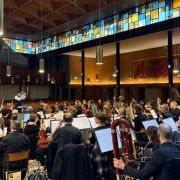
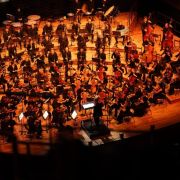
In their third of four visits to this year’s BBC Proms at the Royal Albert Hall, the BBC National Orchestra of Wales were joined by Swiss-Australian conductor Elena Schwarz, making her Proms debut. The bulk of her programme, Mendelssohn’s Violin Concerto followed by Dvořák’s Seventh Symphony, was conventional enough, but her curve ball was the opener. Partly due to this contrast of programming, but also the differing balancing demands placed on the orchestra as a result, this felt like three equally contrasting performances, with varying degrees of success.

Bernd Alois Zimmermann’s Märchen-suite (Fairy-Tale Suite) was only discovered in the late 20th century and premiered in 2001, although composed in 1950 for a Christmas radio broadcast that never happened. Containing plenty of refashioned material from previous works, it is a dark and turbulent suite, yet highly atmospheric. Aside from a brief Musette with dancing flutes and sliding horn lines, and the final Festlicher Epilog (Festive Epilogue), it would work well as a psychodrama film score. The celesta features highly, as does an array of percussion. Two clarinetists are required to switch to threateningly snaky saxophones in one of the darkest sections, Die Erscheinung (The Apparition), with the trumpets pecking back aggressively.


Aggression dominates the stabbing rhythms of Der Ritt durch den Wald (The Ride through the Wood), whilst ghostly wailing from the cor anglais and solo violin over surging and shimmering textures evoke Das verwunsche Schloss (The Enchanted Castle). The sections are short-lived, but the cumulative oppressive atmosphere builds to the final hefty epilogue, and here Schwarz’s larger-than-life gestures encouraged the orchestra to put their full weight behind it. Elsewhere, the strings went from pianissimo shimmering to screaming forte, against shining brass and mysterious, atmospheric woodwinds, in an overall engaging performance of this curiousity.

In the Mendelssohn that followed, violinist Alina Ibragimova brought her chamber credentials to the game in an exquisitely delicate performance, with some remarkably quiet playing, such as in the slow movement’s second-half return of the theme. Some of the time, Schwarz managed to get the orchestra to match Ibragimova’s dynamic range, but elsewhere, it was like the orchestra hadn’t got the memo. So the finale began with an unfortunate effect, the resonance of the orchestral fanfares completely masking Ibragimova’s flicks in response. Ibragimova’s risk-taking dynamics were definitely worth it, drawing the whole hall in for her intimate cadenza, and for her passionately singing slow movement. But full success needed more sensitivity from the orchestra, and unfortunately that wasn’t always on offer. However, the opening movement’s acceleration to presto at the end had real fire, and the finale had the necessary energy to bring things to a rousing conclusion.


Dvořák’s mighty Seventh Symphony had none of the same balancing challenges, and there was a definite sense of reduction in tension from Schwarz and the orchestra, leading to a rendition that was solid and lively, if a little routine. Schwarz felt freer to give big gestures and allow the horns to lead the fuller sound in the opening movement. The woodwinds and horns excelled in the slow movement, with lush, Brahmsian strings, and Schwarz led them efficiently through the dancing cross rhythms of the Scherzo, giving emphatic weight to the hemiolas. The finale fizzed with rattling horns and beefy trombones, building to a triumphant finish, although the slide into the final chords felt a tad rushed – blink and it was all over.
So a concert of three thirds, if you will: all three with fine moments, but none that will go down as the most memorable.